
CITY: Issue 25.5-6

founding editor: bob caterrall

editor: city editors

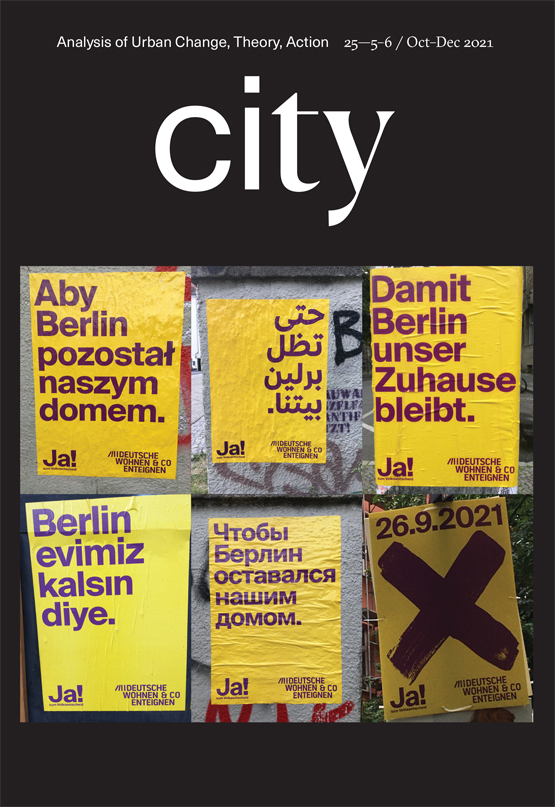
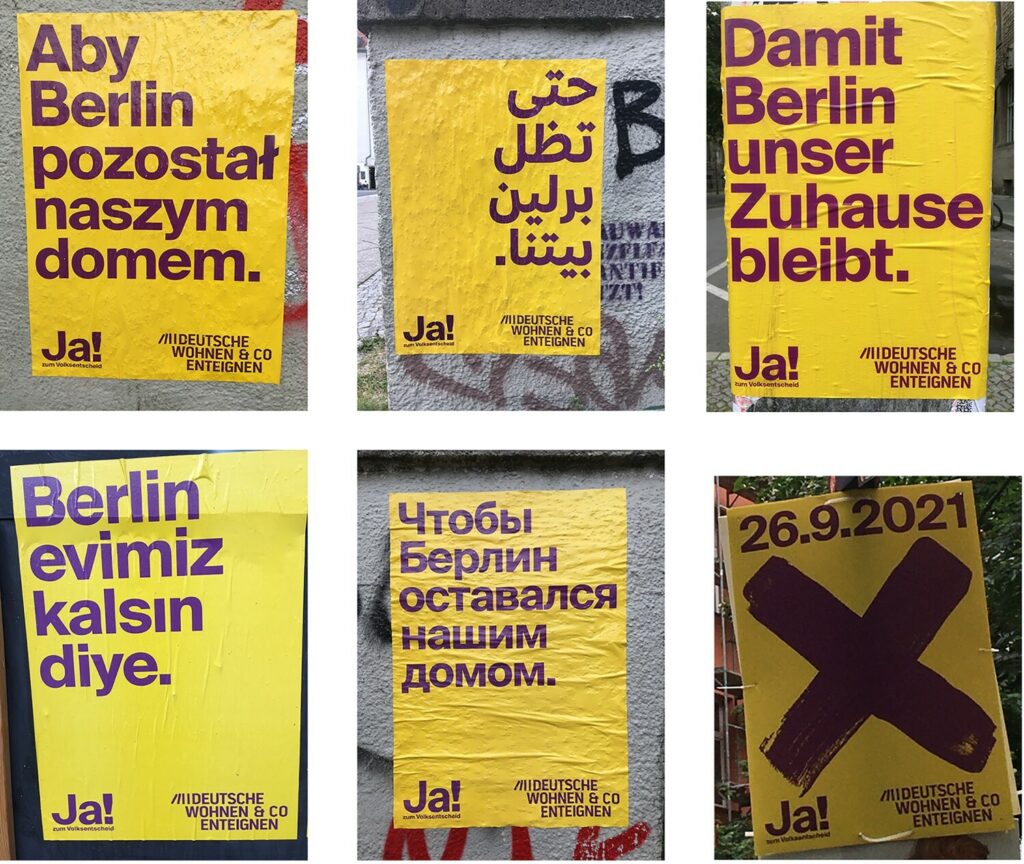
editorial: Ja! Damit Berlin unser Zuhause bleibt! That Berlin will remain our home! حتى تظل برلين بيتنا Berlin evimiz kalsın diye! чтобы берлин оставался нашим домом Aby Berlin pozostał naszym domem!, by anna richter and debbie humphry

Berliners won a major victory and precedent for housing justice on 26 September 2021. There was a clear majority of 57.6% in the referendum initiated by the campaign group Deutsche Wohnen & Co Enteignen (Expropriate Deutsche Wohnen & Co) (2021). Together with the national and local elections, voters in Berlin were asked whether they supported the drafting of a bill to expropriate and socialise housing stock owned by corporate landlords with more than 3000 properties, such as Deutsche Wohnen or Akelius. In 2020, Leilani Farha, the UN’s Special Rapporteur for the Right to Housing, had already accused corporate landlord Akelius of creating a hostile environment for its tenants ‘through severe deterioration of housing conditions, higher rents and increased risk of threat of eviction’ (UNHRC 29 April 2020; see also Gertten 2019). Akelius also explicitly support the deliberate displacement of lower-income households from the city, with Roger Akelius advising Berlin to build a sister city outside the existing perimeter for people with lower incomes as increases in inner city housing prices will be unaffordable for the majority (Tagesspiegel 15 April 2021; see also dwenteignen.de 2021). The demand for expropriation rests on the German constitution’s article 15, which states: ‘Land […] may be transferred to common ownership […] for the purpose of socialisation’. The housing stock in question in the referendum is approximately 240,000 flats, the size of a large city in its own right, so the demanded bill presents a meaningful alternative vision for a more equitable and inclusive kind of housing provision in Berlin. In this editorial, our corresponding editor Anna Richter recounts the morning after the election, and reflects with Debbie Humphry on its implications (see Figure 1).

Figure 1: Deutsche Wohnen & Co Enteignen campaign posters in different languages. Photos: Anna Richter.

The morning following the referendum I cycled past a group of people dancing in front of a bakery, complete with a boom-box and champagne. After the long Covid-induced halt to groups and meetings, partying well into the morning was an unusual sight on an otherwise everyday morning in Berlin Neukölln. The partygoers with yellow-purple high viz vests were a handful of the many, many supporters and campaigners of the Deutsche Wohnen & Co. Enteignen campaign (see Figures 2–6). The revellers were celebrating their victory, our victory, against the excessive profits made by corporate landlords at the cost of a poor deal for tenants and pricing so many low and middle-income Berliners out of their city. We knew we had a victory for the transfer of private property into public social use, a reverse of the insistent trends of the past decades driven by the relentless individualist market economy of neoliberalism. We knew it was an important step towards equality. Yet the simultaneously held local elections resulted in a small victory for the Social Democrats who had already announced that they would not implement the referendum. Beyond the dancing, then, we would need to face this ambiguity.

Figure 2: Throwing at cans named after the corporate landlords Deutsche Wohnen, Akelius, GCP, Vonovia and others. Photo: Ian Clotworthy.

Cycling that morning through Kreuzkölln, Neukölln’s and Kreuzberg’s borderland, there were other small groups still celebrating the victory. Banners hung from many windows and there were campaign stickers on every traffic light. No thought had yet been given to the difficulty of forming a new national government after sixteen years of Angela Merkel, or how the contradictory results in Berlin might impact the non-binding yet still irrevocable demand for the expropriation of corporate landlords and the socialisation of housing. Locally the victory was felt, present and palpable in the streets: there was no doubt that the referendum had been won decisively, in some wards at over 80%. It felt like anything was possible. A feeling that came from a victory shared, won through the dogged work of so many campaigners, their ceaseless presence on the streets over the past months and their many initiatives, messages and symbols that adorned the streets and paved the way for the resounding ‘Yes’ to the Referendum.

to read this editorial in full, please click here

Original Articles

research article pages: 1-6

Making impact strange/making strange impact

Ulises Moreno-Tabarez

published: 2021/3/4

read on taylor & francis →
research article pages: 5-25

Declarations of independence

Sharon M. Meagher

published: 2009/3

read on taylor & francis →
research article pages: 7-26

The art of care

Chandra Russo

published: 2021/3/4

read on taylor & francis →
research article pages: 8-25

The right to community?

Phil Hubbard, Loretta Lees

published: 2018/1/2

read on taylor & francis →
research article pages: 25-32

Introduction

Kurt Iveson

published: 2010/2

read on taylor & francis →
research article pages: 25-42

Wealth creation and poverty creation

Michael Edwards

published: 2002/4

read on taylor & francis →
research article pages: 25-49

Robowar™ dreams

Stephen Graham

published: 2008/4

read on taylor & francis →
research article pages: 25-41

Worlding a city: Twinning and urban theory

Mark Jayne, Phil Hubbard, David Bell

published: 2011/2

read on taylor & francis →
research article pages: 25-40

Assemblages of care and the analysis of public policies on homelessness in Turin, Italy

Michele Lancione

published: 2014/1/2

read on taylor & francis →
research article pages: 25-46

An intensifying and elite city

Niall Cunningham, Mike Savage

published: 2017/1/2

read on taylor & francis →
research article pages: 27-45

Under the wire

Katherine Dawson

published: 2021/3/4

read on taylor & francis →
research article pages: 46-66

Rethinking centrality

Azat Zana Gündoğan

published: 2021/3/4

read on taylor & francis →
research article pages: 67-87

The strange case of earthquake risk mitigation in Istanbul

Deniz Ay, Basak Demires Ozkul

published: 2021/3/4

read on taylor & francis →
research article pages: 88-107

Improving local governance with citizen engagement?

Viktor Bensus

published: 2021/3/4

read on taylor & francis →
research article pages: 108-128

Visual criminology and lives lived in public space

Kajsa Lundberg

published: 2021/3/4

read on taylor & francis →
research article pages: 129-170

Cities coping with COVID-19

David Simon, Angeles Arano, Mariana Cammisa, Beth Perry, Sara  Pettersson, Jan Riise, Sandra Valencia, Michael Oloko, Tarun Sharma, Yutika Vora, Warren Smit

published: 2021/3/4

read on taylor & francis →
research article pages: 164-166

Some geographical thoughts on ‘Flesh and Stone’

Doreen Massey

published: 1996/1/30

read on taylor & francis →
research article pages: 171-186

Ambivalent cosmopolitanism from above in Dubai

Delphine Pagès-El Karoui

published: 2021/3/4

read on taylor & francis →
research article pages: 187-192

Indigenous urban life beyond city bounds: a more-than-urban approach

Naama Blatman

published: 2021/3/4

read on taylor & francis →
research article pages: 193-198

Contextualizing the devaluation of homes in Black neighborhoods

Bo McMillan

published: 2021/3/4

read on taylor & francis →
research article pages: 199-203

Cities consumed by greed

Glyn Robbins

published: 2021/3/4

read on taylor & francis →
research article pages: 204-208

Integrating gender into spatial planning

Henriette Bertram

published: 2021/3/4

read on taylor & francis →
research article pages: 209-212

How a map can dictate reality

Sana Ahrar, Caitlin Flanagan

published: 2021/3/4

read on taylor & francis →
research article pages: 213-217

Moving between I and we: Care and collective work in City

Andrea Gibbons

published: 2021/7/4

read on taylor & francis →
research article pages: 218-234

The case of Booker T. Washington High School

Clare Cannon

published: 2021/7/4

read on taylor & francis →
research article pages: 235-254

When the (face)mask slips

Aiko Ikemura Amaral, Gareth A. Jones, Mara Nogueira

published: 2021/7/4

read on taylor & francis →
research article pages: 255-276

Digital urban nature

Timothy Moss, Friederike Voigt, Sören Becker

published: 2021/7/4

read on taylor & francis →
research article pages: 277-302

Children’s poetics of fragments in a riverside kampung in Yogyakarta, Indonesia

Jorgen Doyle, Hannah Ekin

published: 2021/7/4

read on taylor & francis →
research article pages: 303-314

Thinking the city through work

Katharina Knaus, Nina Margies, Hannah Schilling

published: 2021/7/4

read on taylor & francis →
research article pages: 315-331

Platformization in the third sector

Eva Mos

published: 2021/7/4

read on taylor & francis →
research article pages: 321-341

Speculating on London's housing future

Joe Beswick, Georgia Alexandri, Michael Byrne, Sònia Vives-Miró, Desiree Fields, Stuart Hodkinson, Michael Janoschka

published: 2016/3/3

read on taylor & francis →
research article pages: 332-354

‘Making ends meet’ by renting homes to strangers

Kiley Goyette

published: 2021/7/4

read on taylor & francis →
research article pages: 355-375

Making translations, translating Making

Samantha Cenere

published: 2021/7/4

read on taylor & francis →
research article pages: 376-395

Platform ‘glitch as surprise’

Kavita Dattani

published: 2021/7/4

read on taylor & francis →
research article pages: 396-418

Beyond the hype

Zafeirenia Brokalaki, Roberta Comunian

published: 2021/7/4

read on taylor & francis →
research article pages: 419-435

Against the wall

Anna Carastathis, Myrto Tsilimpounidi

published: 2021/7/4

read on taylor & francis →
research article pages: 436-452

Figuring crisis

Julia Tulke

published: 2021/7/4

read on taylor & francis →
research article pages: 453-473

The more buffed, the more persistent

Natalia Samutina, Oksana Zaporozhets

published: 2021/7/4

read on taylor & francis →
research article pages: 474-485

Negative curation and contested claims over the public visual landscape

Susan Hansen

published: 2021/7/4

read on taylor & francis →
research article pages: 486-496

Images of belonging

Paridhi Gupta

published: 2021/7/4

read on taylor & francis →
research article pages: 497-509

Visualising the right to protest

Piyarat Panlee

published: 2021/7/4

read on taylor & francis →
research article pages: 510-525

Urban dialogues

Sarah H. Awad

published: 2021/7/4

read on taylor & francis →
research article pages: 526-542

Crises and/of representations

Konstantinos Avramidis

published: 2021/7/4

read on taylor & francis →
research article pages: 543-548

Subsidizing housing insecurity

Prentiss A. Dantzler

published: 2021/7/4

read on taylor & francis →
research article pages: 549-552

Defying transience? On giving cosmopolitanism a chance

Michele Acuto

published: 2021/7/4

read on taylor & francis →
research article pages: 553-555

Provincialising smart cities

Paolo Cardullo

published: 2021/7/4

read on taylor & francis →
research article pages: 556-560

Exploring life in the shadows of fast urbanism

Sarah Moser

published: 2021/7/4

read on taylor & francis →
research article pages: 561-569

Ja! Damit Berlin unser Zuhause bleibt! That Berlin will remain our home! <b>حتى تظل برلين بيتنا</b> Berlin evimiz kalsın diye! чтобы берлин оставался нашим домом Aby Berlin pozostał naszym domem!

Anna Richter, Debbie Humphry

published: 2021/11/2

read on taylor & francis →
research article pages: 570-589

Sexualised advertising and the production of space in the city

Emma Arnold

published: 2021/11/2

read on taylor & francis →
research article pages: 590-613

Beverley’s Story

Loretta Lees, Beverley Robinson

published: 2021/11/2

read on taylor & francis →
research article pages: 614-633

Chasing the rent gap down on Edinburgh’s waterfront

Hamish Kallin

published: 2021/11/2

read on taylor & francis →
research article pages: 634-651

The Pit of Shame

Gülsüm Baydar, Selin Güngör

published: 2021/11/2

read on taylor & francis →
research article pages: 652-670

Governing cities as more-than-human entities

Morgan Mouton, Melanie Rock

published: 2021/11/2

read on taylor & francis →
research article pages: 671-697

Off-cycle

Meg Holden, Cédissia About, Claire Doussard, Hugo Rochard, Annika Airas, Apolline Poiroux

published: 2021/11/2

read on taylor & francis →
research article pages: 698-719

Commercial gentrification in Arnhem and Vienna

Michael Friesenecker, Arnoud Lagendijk

published: 2021/11/2

read on taylor & francis →
research article pages: 720-739

Housing precarity

Senyo Dotsey, Francesco Chiodelli

published: 2021/11/2

read on taylor & francis →
research article pages: 740-763

Urban mobilizations and municipal policies to un-make housing precarity

Gabriele D’Adda

published: 2021/11/2

read on taylor & francis →
research article pages: 764-784

The right to public space during the COVID-19 pandemic

Elia Apostolopoulou, Danai Liodaki

published: 2021/11/2

read on taylor & francis →
research article pages: 785-790

A nostalgic look at bygone urban lifestyles in the TV series<i>Pretend it’s a city</i>

Maciej Kowalewski

published: 2021/11/2

read on taylor & francis →
research article pages: 791-793

When the past, present and future of cities collide

Federico Cugurullo

published: 2021/11/2

read on taylor & francis →
research article pages: 794-797

‘Power-difference couplings’ and white supremacy in the Rust Belt

Akira Drake Rodriguez

published: 2021/11/2

read on taylor & francis →
research article pages: 798-802

The durability of deprivation

Rachel Bok

published: 2021/11/2

read on taylor & francis →
research article pages: 803-807

A new grand narrative of decline

Max Rousseau

published: 2021/11/2

read on taylor & francis →
research article pages: 808-812

Foregrounding racism as a cause of urban decline

Jason Hackworth

published: 2021/11/2

read on taylor & francis →

city: analysis of urban change, theory, action journal and website provide a conduit for critical academic debates and theoretical development, considering their implications for everyday lives, urban change and action.