cities
struggles
ideas
always... →
one journal ↴
city: issue 28.3-4
founding editor: bob caterrall
editor: city editors
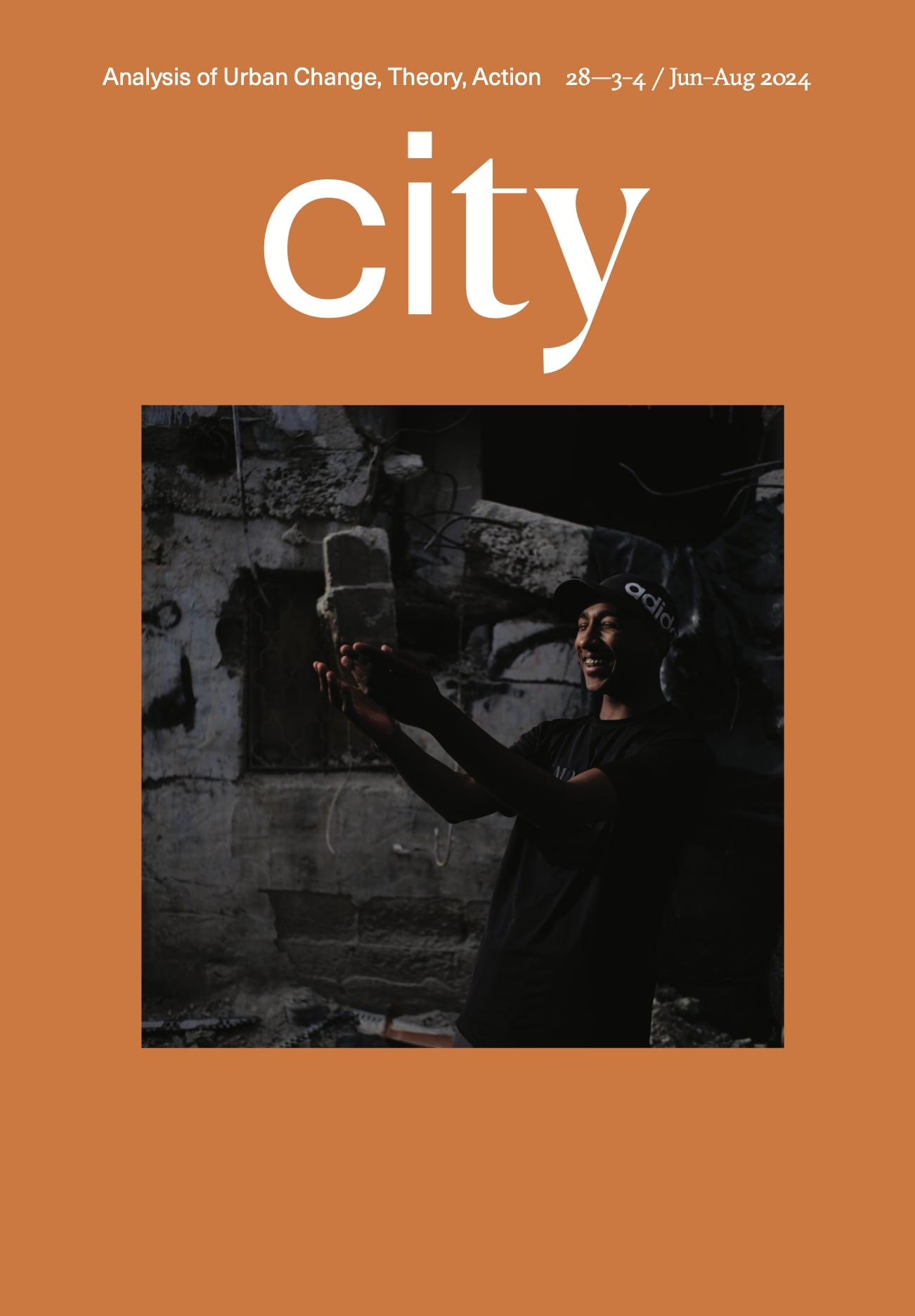
editorial: Forty million minutes: witnessing across generations
Ross Domoney, Antonis Vradis & Waleed Samer
What is the value of testimony? What kind of effect can it bring about? What kind of action may it incite, for example? It is probably a bit early for questions of such nature. First of all, then, allow us to introduce you to our project. This collective editorial reflects on our recent trip to the West Bank, Palestine in April 2024. Our trip was motivated by the desire to produce a film, as well as a series of reports and photos on the everyday life of inhabitants of the Bantustan-like cities of the West Bank. The original idea of the trip, then, was to focus on documenting the daily life of the residents of the West Bank. But we quickly realised that the term is not particularly useful in describing a condition where ‘everyday’ is nothing more than the interval between one disaster and the next. Furthermore, such catastrophes and their intervals are complementary, not opposing moments. There is no longer, in other words, rest or peace, only grief for the loss and fear of the future.
So there was a question of what to focus on, if it wasn’t for everyday life. For example, we could have chosen the material realities of these cities, cities that in many ways challenge our conventional wisdom about them being spaces of freedom, freedom at least from social norms and conventions, a safety in numbers that makes them the wonderfully peculiar spaces that have been the focus of this wonderful journal. So then, an occupied city is a contradiction in terms. And yet, we chose to focus not so much on the physical characteristics of the cities of the West Bank—the narrow alleyways, the tremendous density, the crumbling infrastructure—nor on the brutal everyday reality imposed upon them by the Israeli occupation. Rather, our focus has been on memory and witnessing. Why? Quite simply, because our conversations with our Palestinian comrades revealed, very quickly, that memory and witnessing were at the forefront of their struggle. But this decision was also driven by the fact that we felt that these dense urban settings could be ideal environments for these to be preserved, and to be carried forward.
Prior to commencing our trip, we knew that murderous raids by the Israeli occupation army had increased sharply after October 7, and also that a new generation of armed resistance groups had sprung up in several cities there, including Jenin, Nablus and Tulkarm. And so we ended up in the latter, in the northwestern West Bank, seeing as it was getting less coverage at the time. In addition, we knew that this city is home to both the camps of Nur Shams and Tulkarm, two of the refugee camps of 1948: urban areas hosting populations displaced in the Palestinian Nakba of that year. Finally, we consciously chose to remain in the area almost for the entire trip, knowing that in this way we would be more likely to witness one of the frequent Israeli army murderous raids, as well as all that precedes and follows these. Indeed, between April 18 and 20, the Israeli army carried out one of its most destructive attacks in the West Bank since the Second Intifada on the Nur Shams camp, killing fourteen Palestinians, including at least one child.
In the following pages, we share some thoughts between us who travelled to Palestine and were eyewitnesses to this attack (Ross Domoney and Antonis Vradis) and Waleed Samer, a resident of Nur Shams and our partner in the project. We commence, of course, from completely different starting points, with very different experiences and privileges, or the lack of the latter. But the core idea behind our project lies precisely in highlighting these differences: in Nur Shams we were united by our common hope for an end to the war not vaguely speaking, but marked specifically by Palestinian liberation.
editorial

abstract / preview
Abstract
Forty million minutes: witnessing across generations
What is the value of testimony? What kind of effect can it bring about? What kind of action may it incite, for example? It is probably a bit early for questions of such nature. First of all, then, allow us to introduce you to our project. This collective editorial reflects on our recent trip to the West Bank, Palestine in April 2024. Our trip was motivated by the desire to produce a film, as well as a series of reports and photos on the everyday life of inhabitants of the Bantustan-like cities of the West Bank. The original idea of the trip, then, was to focus on documenting the daily life of the residents of the West Bank. But we quickly realised that the term is not particularly useful in describing a condition where ‘everyday’ is nothing more than the interval between one disaster and the next. Furthermore, such catastrophes and their intervals are complementary, not opposing moments. There is no longer, in other words, rest or peace, only grief for the loss and fear of the future.
original articles

from bangladesh colony to shanthinagar: housing rights, sexuality, and consumption in keralam
keywords: consumption, housing, sexuality, slum, sex workers, kerala
abstract / preview
Abstract
From Bangladesh Colony to Shanthinagar: housing rights, sexuality, and consumption in Keralam
As the developmental state attempted to transform the urban slum in Kerala into a model housing colony, narratives of decency, self-restraint, and sexual discipline became crucial for securing housing rights in the transformed space. ‘Bad’ and ‘good’ consumption; ‘bad’ and ‘good’ poor and images of ‘normality’ and the ‘normal home’ as the abode of the ideal citizen and worker were some of the strategies deployed by the residents of the Bangladesh Colony to encounter the quotidian world of moral non-acceptance. This article examines how neoliberal articulation of rights through government projects often have contradictory effects on the lives of differently positioned women. The moral economy of consumption hinders the realization of the neoliberal ideal of the consumer-citizen. Practices considered as ‘excess’ in consumption by female sex workers were perceived as a threat to this slum community lying on the urban margins, resulting in their expulsion. The article integrates theories of urban assemblage and queer temporality to understand how women sex workers resisted such expulsions. These theories converge on the notion of excess/abundance. Abundance of relationships, of political alliances and strategies, of consumption practices—exceeding heteronormative ideals—was deployed by women sex workers to resist their erasure and confinement into any single identity.

plotting from a plat : tracing spatial design along seattle’s yesler way, 1850s-2010s
keywords: built environments, gentrification, seattle, settler colonialism, urban renewal
abstract / preview
Abstract
Plotting from a plat : tracing spatial design along Seattle’s Yesler Way, 1850s-2010s
Amid the redevelopment of Seattle’s Yesler Terrace, C. Davida Ingram wrote, ‘residents have made their lives possible in places where others only see the impossible.’ Thinking with Ingram, this article asks ‘what goes unnoticed’ in the reproduction of the built environment along Yesler Way over time. In contrast to its plats—the plans and designs undergirding the colonization of sdzídzəlʔalič, renewal of Profanity Hill, and redevelopment of Yesler Terrace—I lift the spatial practices and vernacular spaces of marginalized inhabitants who were simultaneously rendered out of place yet sustained life here. Following interventions in Black Studies, I describe this work as plotting and consider its specific forms in and through the built environment. Alongside this theoretical framework, I suggest critical fabulation as a method that locates and centers inhabitants’ plottings, and as such, reveals histories of and precedents for alternative buildings and landscapes. I caution practitioners and scholars against producing and describing violence in their work, and I instead advocate for learning from inhabitants as they imagine, practice, and create place for themselves.

property-time: serial archives, settler logics, and illiberal space–time oddities
keywords: colonial, global south, illiberal, liberalism, property, property law, serial, settler, space, time, temporality, title, title-by-registration, torrens
abstract / preview
Abstract
Property-time: serial archives, settler logics, and illiberal space–time oddities
Liberal theories of property assume a linear and serialized temporal orientation facilitated by title registries, recording systems, and the exaltation of land archives. These assumptions, what I call ‘property-time’, can be productively put into relation with dominant geographic theories of space in two ways. First, I argue that distinguishing liberal notions of property-time from geographic space–time allows us to observe a key dialectic involving the attachment of value (and capital) to space, a process that tracks alongside contradictions of capitalist desire: the desire to continually reshape space (becoming) and to extract enduring and permanent, individuated value from it (being). Second, liberal temporalities of property struggle to apply in illiberal global contexts. Here, states enact urban accumulation regimes that deviate from linear, individuated and sequential notions of property by manipulating records and surgically erasing past ownership. These acts are often characterized as forms of state variegation and provisionality. They are also endemic to how both capital and value are created and/or arbitraged by states through the land regime. These formations remain difficult to connect to traditional theories about the production of value under capital because assumed time logics of property limit our theoretical capacity to describe illiberal urban accumulation regimes.

maintaining spatial and social order: the role of housing development in governing urban margins
keywords: poverty governance, urban margins, roma, housing development, street-level bureaucrats
abstract / preview
Abstract
Maintaining spatial and social order: the role of housing development in governing urban margins
This paper investigates processes of spatially ordered marginality of Roma in a former industrial town in Hungary. The analysis focuses on local poverty governance tactics and practices that aim to maintain social and spatial order through the regulation and selective displacement of Roma within the city. These practices of controlling Roma marginality are clear manifestations of the spatialization and racialization of poverty and I argue that spatial containment constitutes a new mode of poverty governance that aims to temper local tensions and cement local power. Moreover, these local policies reflect continuity from socialist era practices in terms of governing Roma marginality through disciplining and displacement. In the present context, EU-funded urban rehabilitation projects represent a vital local resource. While ostensibly targeting social integration, the local government in question has used these resources to promote the mobility of ‘deserving’ vulnerable groups and control ‘undeserving’ marginalized Roma through enclosure. Those who are seen as undeserving are racialized and subject to punitive containment while the ‘deserving’ enjoy material support and a sense of belonging to local society, provided they accept the conditions dictated by local government actors. In this way, the emphasis on individual responsibility masks the structural deficiencies of social housing and related social issues and perpetuates different forms of racism.

the geosemiotics of urban transnationalism: a case study of vietnamese commercial landscapes in prague
keywords: vietnamese migrants, commercial landscapes, spatial practices, semiotic landscapes, geosemiotics, diasporic business
abstract / preview
Abstract
The geosemiotics of urban transnationalism: a case study of Vietnamese commercial landscapes in Prague
This study analyzes the discursive social position of Vietnamese migrants represented by three types of Vietnamese commercial places: a large wholesale complex, Vietnamese-run grocery shops on local streets, and stylish chain restaurants in commercial centers. Guided by the notions of semiotic landscapes and geosemiotics, this study analyzes the semiotic dynamic among the spatial structures, visual images, and human activities in and around the study sites. The analysis demonstrates that the spatial representations of Vietnamese in Prague are associated with the spatial-visual discourses of the globalized city. The walled wholesale complex, situated on the margin of the city, serves to discursively segregate the diasporic community from the mainstream society. Ubiquitous grocery stores on local streets paradoxically signify the inconspicuousness of Vietnamese in Czech society. On the other hand, stylish Vietnamese restaurants in commercial centers add sophisticated cultural tastes and are included in the cosmopolitan dynamic of Prague. This geosemiotic study illustrates how geographical centrality and marginality are intertwined with migrants’ commercial practices, reflecting their multilayered positions in the socioeconomic strata of society. In transnational urban spaces, understanding the discursively associated ethnic markers and their urban locations provides important insights into the inclusive and exclusive dynamics of globalized cities.

commanding heights: the role of wealthy ‘starchitects’ in city remaking
keywords: iconic architecture, star-architect, architectural mega project, wealth elite, super-rich, financialization of city life
abstract / preview
Abstract
Commanding heights: the role of wealthy ‘starchitects’ in city remaking
Censuses of the world’s super-rich now include among their ranks several architects whose personal financial position stems from their status as influential ‘starchitects’. We discuss the economic, political and social forces that concentrate fortunes in the hands of a professional elite who are increasingly also members of a global wealth elite. The rise of such starchitects exemplifies how capital flows are generative of subsidiary but important classes of professional agents who have accumulated significant fortunes as a result of city (re)making. Thus a select few in this field possess the kind of ‘money power’ that is generative of a capacity to direct changes in the built environment. Courted by city administrations and super-rich clients starchitects are increasingly charged with delivering symbolic projects that reinforce expansionary circulations of capital. We develop a concept sketch of how a global cadre of starchitects and their practices are fundamentally aligned with the shift of many cities to plan star-driven vehicles in order to capture capital. We discuss three elements that are crucial in determining the agency of starchitects: first, economic and political constraints or opportunities; second, normative conditions within industry and city institutional contexts; and, third, the important role of professional and power networks.

undoing business: revealing critical narratives in an edge-city business park through nature-based auto-photography
keywords: business parks, non-place, nature, worker voice, auto-photography, sustainability
abstract / preview
Abstract
Undoing business: revealing critical narratives in an edge-city business park through nature-based auto-photography
Business parks are a ubiquitous feature of city-edge development. They have attracted attention for their lack of sustainability, spurring interest in how they can be reconfigured or reimagined in the face of ecological collapse and social fragmentation. Inspired by calls to notice everyday practices at the city edge (Tzaninis et al. 2021. “Moving Urban Political Ecology Beyond the ‘Urbanization of Nature’.” Progress in Human Geography 45 (2): 229–252; Tsing 2015. The Mushroom at the End of the World: On the Possibility of Life in Capitalist Ruins. Princeton: Princeton University Press; Gandy 2022a. “Ghosts and Monsters: Reconstructing Nature on the Site of the Berlin Wall.” Transactions of the Institute of British Geographers 47: 1120–1136.) and drawing on data from a participant-led photography exercise at a suburban business park in the north-east of England, this article explores how workers employed at businesses on the park engage with and value its natural assets. We set out from Tzaninis et al.’s (2021) contention that the dominant framing of suburbia as ‘non-place’ or ‘no man’s land’ has the effect of denying the many intriguing practices unfolding at the city’s edge. Resonating with Tsing (2015), we highlight the significance of everyday interaction with nature in an ecologically vulnerable landscape as a creative, open-ended and, potentially, hopeful process. Focused on denizens of the business park, our data draws attention to the possibilities and potentialities of more-than-human encounters, the feeling of tranquillity generated by green spaces, and the sense of freedom that derives from bodily movement in a natural setting. These open-ended practices are distinct from, and ‘other than’, the dominant way of doing business in the park. Such encounters, drawn out by auto-photography, foment a radical connectedness with nature through which a powerful sense of custodianship and responsibility can find expression.

the art of resisting mega-event amnesia: reconstructing urban memory post-expo in sydney and brisbane
keywords: collective memory, urban imaginaries, public history, visual media, public art world expos, world fairs, international expositions, mega-events
abstract / preview
Abstract
The art of resisting mega-event amnesia: reconstructing urban memory post-expo in Sydney and Brisbane
This article examines the work of ‘image construction’ and ‘memory reconstruction’ by focusing on World Expos held in Sydney and Brisbane, Australia. We argue the construction of urban imaginaries through triumphal narratives induces a form of mega-event amnesia: the erasure from collective memory of communities and cultural artefacts, and the suppression of protest and resistance against these events. We then show how art can be used as a form of ‘memory reconstruction’. Two case studies offer alternative narratives in the form of public art and archival media. The first case forges new storylines that remember Aboriginal culture and language through a major public art project in the heart of Sydney. The second discusses how a digitised archival film made by feminist filmmakers spotlights decades of disregard for the destruction of Brisbane’s working-class inner-city fabric when made accessible to new audiences. These alternative narratives reconstruct the memory of the 1879 Sydney International Exhibition and Brisbane’s World Expo 88 to show how art may be used to awaken urban memories and collective remembrance. Alternative narratives also breathe new life into the complex and contested histories of mega-events. While protest and ‘the art of dissent’ have been widely discussed regarding the Olympics, few scholars have considered their relationship to World Expos. Fewer still have considered how art reconstructs and reinterprets mega-events decades after they were held.
special feature: making the civic city: architectural interventions and experiments in the urban

special feature: making the civic city: architectural interventions and experiments in the urban
keywords: architecture, citizenship, conviviality, public space, urban infrastructure
abstract / preview
Abstract
Special Feature: Making the civic city: architectural interventions and experiments in the urban
This Special Feature seeks to inform contemporary debates about the role of architectural design on the development (or not) of civic cultures within our cities. Contributors to this Special Feature present research that covers a wide spectrum of case studies that demonstrate the influence of urban design on the articulation of new models of citizenship, and the role of architecture in shaping patterns of exclusion in contemporary cities. In response to these issues, we highlight how the effects of architectural elements within their individual buildings can have much wider social implications in terms of the often impoverished dynamics of the urban spaces they foster; we offer examples of how urban infrastructures hold the potential for animating more just public cultures; and we review examples of the convivial cultures that support citizenship on the ground in cities today. In the final analysis of the impact of architectural interventions in the development of civic cultures, we argue that urban researchers should work with methods that trace the sonic qualities of public space in order to supplement visual approaches to the urban.

arrive and retreat: london’s ultra-prime apartment blocks as dark urban renaissance
keywords: super-rich, segregation, wealth, housing, urban renaissance
abstract / preview
Abstract
Arrive and retreat: London’s ultra-prime apartment blocks as dark urban renaissance
The expansion of an archipelago of residential blocks across London’s West End has created an urban renaissance of sorts, but it is a rebirth that has targeted the expanded ranks of the global super-rich, yielding a visibly luxurious, often vacant residential remaking, rather than the aspirations for a diverse, vibrant and open urbanism envisaged some years ago for the city. New luxury apartment blocks offer high levels of privacy, security and the seamless integration of bodies and vehicles into underground or enclosed entry points. These ‘ultraland’ blocks are less places of conviviality and encounter, offering instead a kind of dark space urbanism that facilitates a partial social engagement with local environs by barely present owners. Combining an analysis of the planning applications for these developments with extensive street observation in London’s West End we discuss the social and spatial integration of these developments. We argue that a key effect is one of social ‘reduction’—the sense of null spaces that absorb bodies, furnishings and cars in ways that are the antithesis of earlier ambitions for socially vital and democratic urban spaces. We discuss the significance of these changes for contemporary life in the city more broadly.

the politics of public space at são paulo’s parque minhocão
keywords: brazil, são paulo, infrastructure, public space architecture, expressway, motorway, park
abstract / preview
Abstract
The politics of public space at São Paulo’s Parque Minhocão
São Paulo’s Minhocão (Big Worm) is a 3.5 km elevated expressway that cuts across a dense part of the central city. Opened in 1971, it was controversial from the start, and widely held responsible for the decline of the city’s historic centre in the 1970s and 1980s. However, it has been gradually tamed over the years, first closed to traffic at night, and then at weekends and on holidays, becoming an impromptu park, the Parque Minhocão, which has had official status since 2014. Those informal closures have been accompanied by numerous architectural schemes over the years to make the Minhocão a permanent park on the lines of New York’s High Line. The Parque Minhocão in its present condition represents a stand-off between various interest groups, all of whom have claims on it as public space. The paper explores the history of the Parque Minhocão since 1969 through different forms of visualisation, arguing that its present condition, however imperfect, keeps multiple and contradictory interests in balance.

co-dreaming climates: public space for more-than-human socialities
keywords: planetarity, listening, more-than-human, pedagogical tools, critical spatial practice, publics
abstract / preview
Abstract
Co-dreaming climates: public space for more-than-human socialities
In the face of ongoing but unevenly distributed planetary catastrophe and, in the words of Patricia Reed, an urgent need to ‘make inhabitable worlds in common’, I argue for listening as a mode of urban spatial practice that offers the opportunity to remake our relations with more-than-human others. Recent work in sound studies has explored the potential of listening to create mutuality, dissent, and agency; here I am interested in how pedagogical tools can be designed to support these more radical modes of listening. Weaving essay writing with transcribed audio from a web tool that deploys field recordings and from staged conversations around food, I share experiments drawn from collaborations over the past two years. This is work developed as an architectural researcher, working with performance-makers, sonic artists, urban curators, natural scientists, and community and cultural organisations who are seeking to make public space for climate. Through this transdisciplinary praxis, listening is deployed to produce personal and social affects, space for political encounter, and attunement to ecological relations. In coming together to listen, we sought to create spaces for co-dreaming climates, where climate is understood as in crisis, as atmosphere, and as potentiality.

fragments of citizenship: contested mosque architecture in the north of england
keywords: mosque architecture, citizenship, islamophobia, nativism, urban infrastructure
abstract / preview
Abstract
Fragments of citizenship: contested mosque architecture in the North of England
This paper examines the planning process behind the construction of a mosque building in the English city of York, to demonstrate how it is entangled with contested ideas of national identity. We argue that the politics of religious architecture, particularly mosque planning and architecture, serve as a litmus test for the ways multiculturalism is experienced in contemporary Britain. We explore objections during the planning process for this mosque alongside letters to a local newspaper, where objections included the effect of the mosque on urban infrastructure, the symbolic identity of the mosque within the wider city, and how the mosque would affect claims to citizenship more widely. Objections to this mosque application indicate that architecture and the urban environment are core elements of national identity, and it is through the planning process (of religious buildings) that claims about ‘who is a citizen’ are articulated. Democratic planning processes around the construction of individual buildings can allow groups to organise resistance to much wider cultures of multiculturalism and act as platforms for Islamophobic sentiments. We argue that planning processes work as discursive registers through which architectural aesthetics, cultural identities and fears of otherness are wrapped into the wider politics of public space.

the curious case of atrium urbanism: voids in and of capitalism
keywords: architecture, voids, capitalism, atrium, space
abstract / preview
Abstract
The curious case of atrium urbanism: voids in and of capitalism
All produced spaces are curious since they could, by definition, be different. Atriums—double height or greater vertical voids typically to be found in skyscrapers’ lobbies—are an interesting illustration of this general contention. An internal feature of super-tall architecture the world over, the atrium flourishes in parts of cities where land value is high and given that atria could be occupied with directly rentable space this is an ostensibly puzzling affinity. Drawing primarily on the ideas of Henri Lefebvre and Walter Benjamin, this paper suggests that the presence of atria in major commercial—and increasingly public—buildings grows from oblique attempts to generate surplus value. Paradoxically, it is the voided space of the atrium that explains this strategy. My argument is that voids of open space can actually increase the value of objects, bodies, and practices that are assembled in and around them; paradoxically ‘emptiness’ itself can be monetised in a context of rentier capitalism. Defamiliarising the atrium, which is a distinctive and singular architectural feature of this moment, suggests a wider research agenda for those interested in critical analysis of the contradictory spaces that are produced when capital builds.
scenes sounds action

reclamations from london’s edgelands
keywords: poetry, reclamations london olympics, lower lea valley
abstract / preview
Abstract
Reclamations from London’s Edgelands
Reclamations is an urban pastoral sequence of poems set in the Lower Lea Valley – an open green space within the bounds of the city, a geographic and social edgeland between town and country. The wreckage and remnants of war and urban infrastructure such as sewage works, filter beds, impounded and culverted rivers act as settings. The recycling of waste, absorption of floodwaters and presence of pits and burial grounds – vital features of the marshes for which they are devalued or shunned – figure in the poems, not as dead spaces or discarded processes, but as integral to ongoing renewal, of history alive and remade in the present. The people who populate the poems are also marginalised – ex-soldiers, redundant workers, displaced Travellers, migrants, asylum seekers – but it is traces of their presence left in the landscape and in the language which resonate in lyric and verbatim poems. Underlying the collection is the metaphor of reclamations – not only the process of reclaiming land from the marshes which the Olympics set in train, but the contested claims of whose land it is, the overlooked, suppressed or forgotten histories and voices embedded in the marshes. The sequence echoes their regenerative capacity to take in waste, rubble and flood waters and transform them into productive crafts, industries, recreations and a wild ecology, absorbing at the same time the marginalised, giving us a space to breathe and a place where we can feel at home.

reclaiming an architectural royal institution: mapping the just transition lobby’s riba presidential take-over
keywords: architectural profession, built environment, just transition, activism, campaign
abstract / preview
Abstract
Reclaiming an architectural royal institution: mapping the Just Transition Lobby’s RIBA presidential take-over
The election of Muyiwa Oki in 2022 as the youngest, the first worker and the first Black president of the Royal Institute of British Architects signified a break with a centuries-old status quo. The open and vocal campaign, led by a wide collective of early-career architects and built environment professionals, contrasted with the traditional behind-the-scenes machinations of an established architectural elite. This narrative aims to report the foundations of the campaign by plotting the chronological movements of the constituent activists both within and without the institute. We examine the mechanisms through which we were able to leverage our collective positions to tip the balance of power in favour of a youth-led movement founded on conditions of social and ecological justice. We reflect on changing voting rules, establishing governance positions, consolidating public perception, exerting pressures by grassroots campaigners, and finally challenging the status quo of the traditional seat of architectural power. We discuss the campaign's strengths in operating in a transparent and open manner. We present key learnings about the levers of power within established learned societies and professional institutes.

monuments in motion: contemporary art, public memories and urban identities
keywords: contemporary art, monuments, collective memories, urban identities
abstract / preview
Abstract
Monuments in motion: contemporary art, public memories and urban identities
This photo essay is an exploration of how monuments, that try to give coherence to our shared past and identity, can be rethought through modern art. Specifically, it centres on an art festival in Balaguer, Spain, where an art installation titled MONUMENT by the MITO Collective was set up close to an existing monument of a 18th century Spanish conquistador. During the festival, the monument of the conquistador was vandalised and subsequently removed. The photo essay shows that instead of being static symbols, monuments can be lively spaces that encourage us to talk, question the usual stories told by history, and engage more actively with our collective memories. By presenting reactions to the MONUMENT installation, which featured slogans from various social movements, it suggests that monuments can be places where ongoing stories and conflicts are acknowledged. This shift in perspective invites us to keep rethinking how history can be negotiated in public places, making room for a wider range of voices and stories.
reviews
abstract / preview
Abstract
Giving urban motion a ‘grip on the ground’
No abstract available yet for this article.
abstract / preview
Abstract
Democracy beyond the state
No abstract available yet for this article.