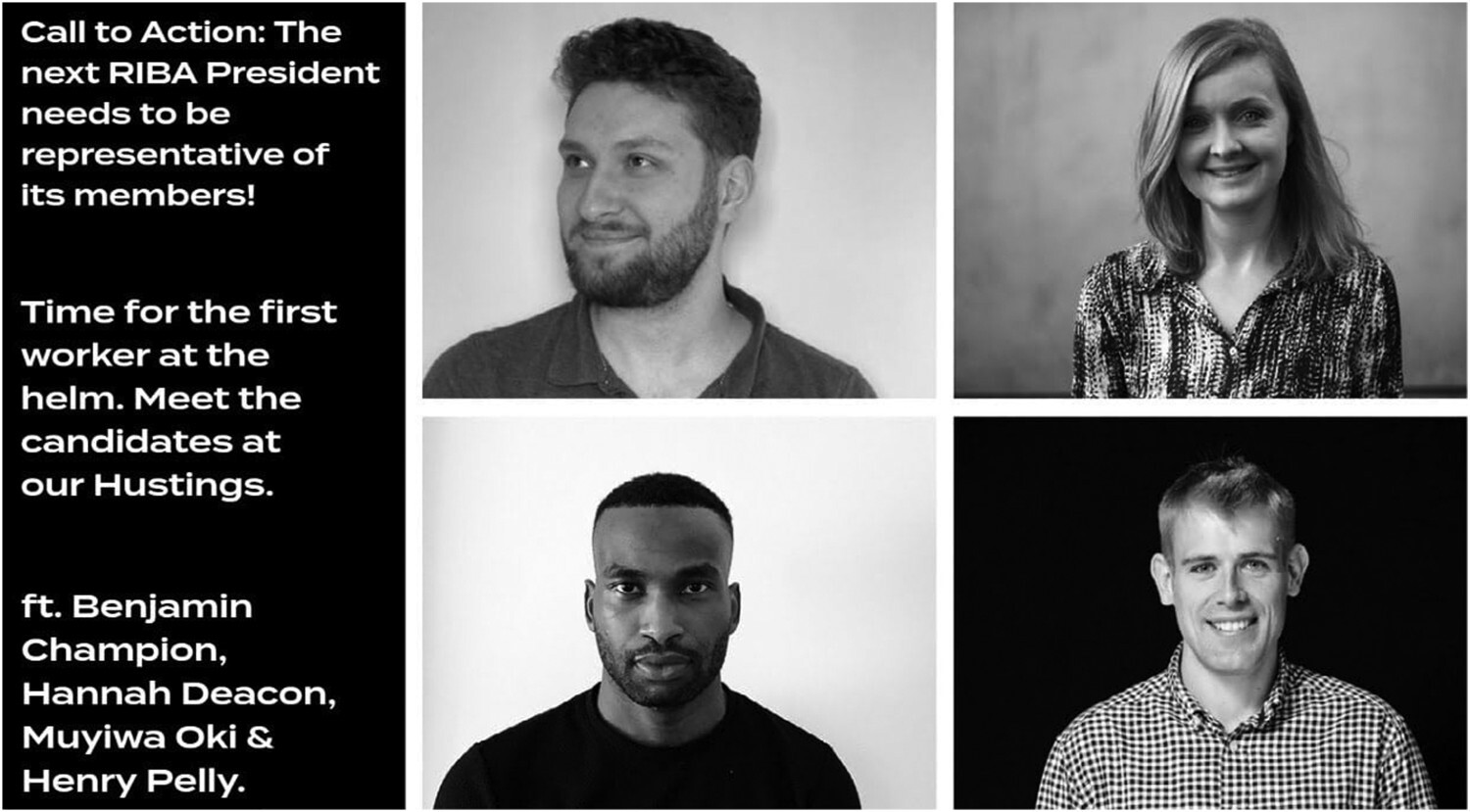
the election of muyiwa oki in 2022 as the youngest, the first worker and the first black president of the royal institute of british architects signified a break with a centuries-old status quo. the open and vocal campaign, led by a wide collective of early-career architects and built environment professionals, contrasted with the traditional behind-the-scenes machinations of an established architectural elite. this narrative aims to report the foundations of the campaign by plotting the chronological movements of the constituent activists both within and without the institute. we examine the mechanisms through which we were able to leverage our collective positions to tip the balance of power in favour of a youth-led movement founded on conditions of social and ecological justice. we reflect on changing voting rules, establishing governance positions, consolidating public perception, exerting pressures by grassroots campaigners, and finally challenging the status quo of the traditional seat of architectural power. we discuss the campaign’s strengths in operating in a transparent and open manner. we present key learnings about the levers of power within established learned societies and professional institutes.
Keywords:
introduction
in 2022, one of us—muyiwa oki—made history as the youngest ever president-elect of the royal institute of british architects (riba), the only worker (meaning an employee without the power to fire or hire) to ever be in the position, as well as the first black person to be elected to the post. the riba was founded in 1834, the oldest architectural institute in the world, carrying a well-established and respected international brand. shaped in the age of empire, the institution has retained many features of that period—opaque structures, perceptions of a london-centric boys’ club and an affinity to privilege. for an institution that has never officially acknowledged and reflected on its colonial past, a president-elect with nigerian heritage carries with it a charged symbolism and hope for many (gordon 2022). the concurrent appointment of the first black riba ceo in 2022—valerie vaughan-dick—means that, of the three most important governance positions, in september 2023 only the chair of the board carries the associations of the ‘old guard’ (carlson 2022; marshall 2020). we, the just transition lobby campaign group, coordinated muyiwa’s election as a collective of early-career architects, activists and professionals, interested in reforming the institute from the inside out, with a particular focus on addressing the climate and biodiversity crisis (jessel 2022a). we hope to initiate a process of solidarity with the early-career and marginalised communities of our sister institutes representing regulated or self-regulated professions, such as engineers, planners, surveyors, builders and others, so they may reclaim and reform their own professional bodies.
reforming the professions
professionalisation of the built environment disciplines since the 19th century has seen architects, engineers, planners and urban designers, formalise their status and establish professional bodies. at the core of professionalism sit trust and the exercise of judgement based on specialist knowledge (duffy and rabeneck 2013). professional institutes’ role is to maintain the trust of the public and to regulate the standards its members must meet. it is in this context of self-regulation that professions hold a potential for rapid reform of knowledge and practice to serve the general public.