cities
struggles
ideas
always... →
one journal ↴
city: issue 30.1–2
founding editor: bob catterall
editor: city editors
in lieu of an editorial
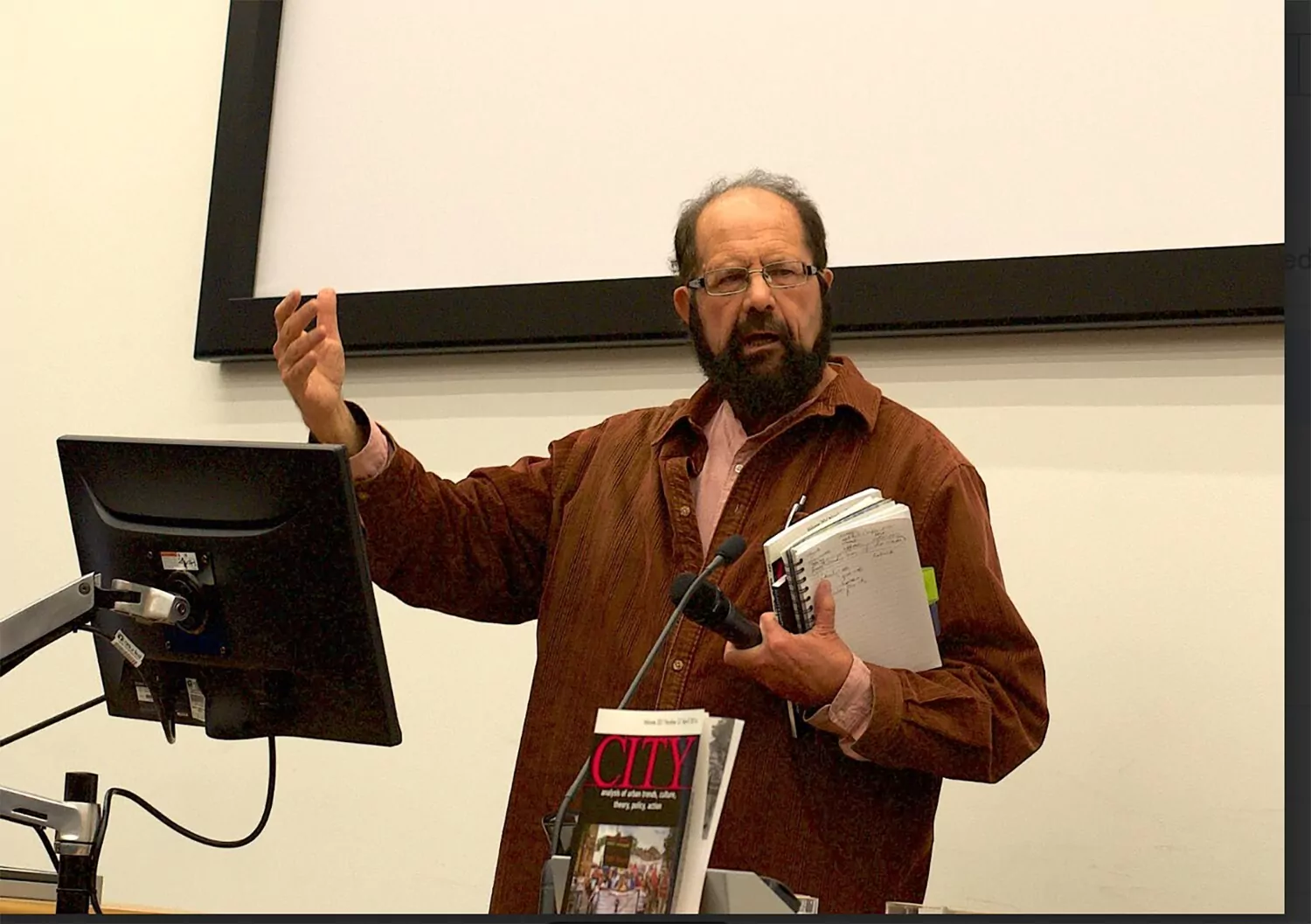
the founding editor of city, bob catterall, passed away on 30 july 2025. he is missed by many in the critical urban studies world and beyond. here a few city contributors offer short reflections and memories in bob’s honour.
introduction
abstract / preview
Abstract
In lieu of an Editorial
The founding editor of CITY, Bob Catterall, passed away on 30 July 2025. He is missed by many in the critical urban studies world and beyond. Here a few CITY contributors offer short reflections and memories in Bob’s honour.
commentaries
abstract / preview
Abstract
Commentary
"Commentary." City, 30(1-2), pp. 2–3
abstract / preview
Abstract
Commentary
No abstract available yet for this article.
abstract / preview
Abstract
Commentary
"Commentary." City, 30(1-2), pp. 7–8
abstract / preview
Abstract
Commentary
"Commentary." City, 30(1-2), p. 9
abstract / preview
Abstract
Commentary
"Commentary." City, 30(1-2), p. 10
abstract / preview
Abstract
Commentary
"Commentary." City, 30(1-2), pp. 11–12
abstract / preview
Abstract
Intergenerational CITY
No abstract available yet for this article.
original articles

thinking through material incompletion
keywords: authoritarianism, futurity, tinkering, uncertainty, speculation, urban otherwise
abstract / preview
Abstract
Thinking through material incompletion
In an era of accelerated urban development driven by future orientation—what does incompletion do and what are its social effects? Based on ethnographic work in Lobito, Zurich and Delhi, we push back against what we call here the ‘tyranny of completion’ both analytically and methodologically, by showing how incompletion emerges as a mode of anticipatory future-making. We focus on incompletion as a constitutive element of speculative urbanism, on the authoritarian efforts to eliminate it from the urban fabric, and on how it creates space for experimentation with form and structure. We posit that attending to incompletion allows us to closely observe futures beyond those conceived by the techno-managerial class that initiates speculation. Furthermore, a focus on incompletion enables us to resist the colonizing ambitions of projects that seek to foreclose the future. Moreover, incompletion offers experimental spaces, allowing marginalized and subaltern actors to animate an urban otherwise. With this analytical gesture, the materially incomplete becomes a space of possibilities and care in an era of geopolitical uncertainty. It is one that forges social positionalities and vernacular relations that defy the financial and authoritarian logics of futurity, all the while keeping an orientation towards alternative futurities.

urban reorderings: informality, emotional governance, and the remaking of home in buenos aires
keywords: housing policies, informal settlements, emotional governance, urban citizenship, moral economies, relocation
abstract / preview
Abstract
Urban reorderings: informality, emotional governance, and the remaking of home in Buenos Aires
State-led housing relocations are not merely about shelter; they are political and emotional interventions that reshape urban life. This article examines how social housing policies in Argentina operate as affective technologies of government and urban ordering. Drawing on ethnographic research conducted within a relocation program in the metropolitan region of Buenos Aires, it analyzes how families moving from informal settlements to state-built housing complexes navigate profound shifts in material conditions, moral expectations, and affective attachments. Rather than conceiving informality as the absence of the state, the study draws on critical urban theory to understand it as a differentiated zone of regulation. Relocation thus emerges not as a linear path to inclusion, but as a contested process of political inscription that redefines who belongs in the city and under what conditions. By foregrounding the entanglements between dwelling, affect, and urban power, this article contributes to critical debates on informality, moral economies, and the production of urban citizenship in Latin America.

redefining urban liveability through community voices: insights from kumasi’s informal settlements
keywords: urban liveability, informal settlements, southern urbanism, critical urban theoryright to the citykumasi
abstract / preview
Abstract
Redefining urban liveability through community voices: insights from Kumasi’s informal settlements
This paper argues that ‘urban liveability’ is not a neutral metric but a powerful political discourse that is mobilised to advance specific urban visions while actively marginalising informal settlements. Challenging the hegemony of Western-centric frameworks that dominate urban policy, this study uses participatory methods to build a theory of liveability from the ground up, based on the lived experiences of residents in two of Kumasi, Ghana’s informal settlements—Aboabo and Suame Magazine. Our analysis reveals six interrelated dimensions that define liveability as a political claim, centred on the struggles for: essential infrastructure, economic opportunity, healthcare, environmental safety, community resilience, and housing security. These findings demonstrate that residents’ definitions of a liveable city are forged in response to systemic neglect and are rooted in collective survival rather than individualistic consumption. By foregrounding these subaltern perspectives, this research does more than fill a geographical gap; it unsettles urban theory by reframing liveability as a site of political contestation over the right to the city. The study provides a robust, critically grounded framework for scholars and advocates seeking to challenge dominant urban paradigms and centre grassroots knowledge in the pursuit of more just and equitable urban futures.

sensing regeneration in a working-class dublin suburb
keywords: sensory symbolic displacement, heat, senses, regeneration, neoliberalism, social housing, ballymun
abstract / preview
Abstract
Sensing regeneration in a working-class Dublin suburb
This article focuses on the regeneration of Ballymun, a working-class Dublin suburb built in the 1960s as a utopian high-rise estate for social housing tenants. However, following the estate’s rapid deterioration both economically and socially, the suburb underwent a process of regeneration at the turn of the millennium, which saw the complete demolition of the high-rise buildings and the rebuilding of the estate as a low-rise area. The article explores how the neoliberalisation of the Irish welfare state, as reflected in the spatial transformation of Ballymun, is intimately experienced by the residents through their senses, particularly through thermal perception. The shift from a collective, state-provided heating system to an individualised, responsibility-based model reflects a broader neoliberal policy and has profoundly affected the residents’ sense of belonging and sense of place. It is argued that the changes in the sensory perception of warmth in residents’ homes before and after regeneration have contributed to their sense of symbolic displacement: through the changes in sensory experience, the article argues, residents experience ruptures in their sense of place, home and community.

shadows on the wall: epistemic im/purity and the politics of peer review in urban research journals
keywords: epistemic care, epistemic humility, epistemic impurity, knowledge exchange
abstract / preview
Abstract
Shadows on the wall: epistemic im/purity and the politics of peer review in urban research journals
This perspective interrogates the epistemological foundations of peer review in urban research journals through the concept of epistemic im/purity, the entrenched belief that valid knowledge should conform to supposedly objective and universal standards. Drawing on Plato’s Allegory of the Cave, it argues that some peer review practices trap scholars in a shadow world, privileging familiar paradigms while obscuring situated, plural, and justice-oriented forms of knowledge exchange. These dynamics expose a critical argument regarding reviewer competence: can mixed-methods research be evaluated without defaulting to disciplinary notions of purity, and are reviewers prepared to recognize when impurity itself becomes uncritical or functions merely as epistemic tokenism? Building on work on radical unknowability in complex urban systems, epistemic humility, and critiques of concentrated authority in peer review, the paper moves from critique to construction. It treats both humility and impurity as practices of epistemic care, highlighting impurity’s liberating potential when cultivated through thoughtful, situated, and reflexive engagement.

public relations, repression, and counter-insurgency: the overlapping functions of police ‘co-response’ teams in montréal
keywords: police, policing, community policing, counter-insurgency
abstract / preview
Abstract
Public relations, repression, and counter-insurgency: the overlapping functions of police ‘co-response’ teams in Montréal
In the last twenty years, police ‘co-response’ teams have become an increasingly common feature of urban policing. As the term suggests, co-response teams bring together police and non-police personnel to train, patrol, or otherwise operate together. The involvement of non-police personnel (e.g. social workers, mental health professionals) can seem to contribute to a different approach than conventional policing: more supportive, less repressive, and more problem-oriented. The literature on co-response teams, however, remains sparse and disconnected from relevant critical literatures. To address this limitation, this article situates co-response teams within the larger literature on community policing. Connecting insights from this larger literature to an empirical analysis of co-response teams in Montreal, Canada, the article argues the teams carry forward the core functions of conventional policing and, in fact, seek to resolve an ongoing crisis in police hegemony in three ways: (1) they are a public relation scheme that allows unreformed police practices to persist undisturbed; (2) they are a strategy to gather consent for expanded police repression; and (3) they are a form of domestic counter-insurgency, which serves to neutralize sites of political resistance against police power.

dismantling urban sanctuary and the ‘migrant crisis’: the political economy of solidarity and providing support to asylum-seeking migrants in new york city
keywords: sanctuary city, solidarity, asylum, asylum seekers, neoliberal governance, punitive market sanctuary, self-sufficiency, new york city, migrant crisis
abstract / preview
Abstract
Dismantling urban sanctuary and the ‘migrant crisis’: the political economy of solidarity and providing support to asylum-seeking migrants in New York City
In this article, I analyze the underlying logic and the effects of New York City’s sanctuary and migration policies through the lens of asylum-seeking migrants’ arrival. Specifically, I qualitatively trace the development of the policies and practices of the urban government, service providers, and migrant organizations between 2018—when the conditions of asylum seekers received wider scrutiny because of Donald Trump’s ‘zero tolerance’ approach—and 2023, when the city’s ‘migrant crisis’ escalated. My findings illustrate that the emergency governance evolving as a response to the ‘migrant crisis’ has exacerbated austerity and labor-centered approaches aimed at enabling asylum seekers’ exploitation. This produces what I call a ‘punitive market sanctuary’ through which access to city support and care is not only contingent on asylum seekers’ deservingness but on their racialized value and submission to the capitalist extraction of labor. Engaging with literature on sanctuary, solidarity, and urban migration governance, this article contributes a political economic perspective to debates about sanctuary and solidarity cities. It reveals how the growing politics of the ‘migrant crisis’ play out across urban locales, turning multiculturalist sanctuary policies into a repressive form of authoritarian migration governance applied to manage racialized and exploitable populations while dismantling city services for several residents and communities.

anchoring the city in time and space: an architectural exploration of the processual city in jai undurti’s hyderabad: a graphic novel
keywords: cityscape, processual nature, architecture, memory, everyday
abstract / preview
Abstract
Anchoring the city in time and space: an architectural exploration of the processual city in Jai Undurti’s Hyderabad: A Graphic Novel
Contemporary academic discourses regard cityscapes as having a generative effect on their inhabitants; cityscapes are continually produced and modified even by the most ordinary of interactions. The architecture of the graphic medium enables the narrativization of these spaces in unparalleled ways, making it one of the best-suited mediums to discuss urban landscapes. Published in 2017, Jai Undurti’s Hyderabad: A Graphic Novel is one such graphic storytelling initiative that explores the eponymous city. Undurti uses time travel to play with Hyderabad’s varying chronotopes to piece together the stories of the inhabitants living in Hyderabad in different time frames. The paper argues that the city Undurti presents is processual in nature, manifested through architecture. The infrastructure expresses the contrasting essence of the city's ancient nature and the progression of modernization. The paper critically examines the role of architecture in the process of place-making. The paper draws on Pierre Nora’s Les Lieux de Mémoire to examine sites where memory inscribes and archives itself, and employs Dominic Davies’ notion of architecture as ‘political plastic’ to interpret the layered meanings of neoliberal infrastructure.

beyond ‘should they stay, or should they go?’ the management of contested statues in flanders from an evolutionary governance perspective
keywords: heritage management, evolutionary governance, policy change, urban fallism, contested heritage, colonial heritage
abstract / preview
Abstract
Beyond ‘should they stay, or should they go?’ The management of contested statues in Flanders from an evolutionary governance perspective
In light of global movements targeting contested monuments, this study explores the management of colonial-era statues in Flanders, Belgium, through the lens of Evolutionary Governance Theory (EGT). While international ‘urban fallism’ has catalyzed public debate and policy shifts, Flemish municipalities display a notably restrained approach towards contested statues. This paper investigates whether societal discussions on colonial heritage and urban fallism translate into institutional change in heritage management at the municipal level. Based on a qualitative case analysis of Flemish municipalities and interviews with local policy actors, the research reveals a largely reactive, ad-hoc governance approach. Most local governments exhibit reluctance to address colonial statues unless provoked by external pressure or public unrest, with only a few urban municipalities showing signs of adaptive and participatory heritage policies. A co-evolutionary perspective uncovers the complex interdependencies between societal discourse, political steering and institutional inertia, offering insights into the challenges of effectuating heritage policy change. While debates may serve as catalysts, they seldom result in structural policy transformation. Based on our data set collected up to 2022, the paper concludes by arguing for more adaptive, participatory governance frameworks that acknowledge both local contingencies and broader sociopolitical dynamics, thereby shifting the conversation beyond the binary of whether statues should simply ‘stay or go’.
special feature: coastal commons: littoral urbanisms, afro-indigenous relations, and small coastal cities

introduction to the special feature. coastal commons: littoral urbanisms, afro-indigenous relations, and small coastal cities
keywords: coastal commons, littoral urbanisms, afro-indigenous relations, small coastal cities, racialised urbanisation
abstract / preview
Abstract
Introduction to the Special Feature. Coastal commons: Littoral urbanisms, Afro-Indigenous relations, and small coastal cities
Coastal Commons brings together a set of visual essays that read urbanisation from the littoral, where water, work, ritual, and governance meet at small scale and close range. Grounded in sustained collaboration across the Costa Chica of Guerrero and Oaxaca, the Special Feature treats Afro Indigenous not as a prescriptive identity label but as a geohistorical analytic for coastal relations, and it foregrounds refusal and repair as practical and conceptual orientations. The contributions are organised through three braids, water as commons and labour as care; ritual, refusal, and the spectral commons; and governance, recognition, and the price of being seen. Across these braids, the essays examine infrastructural neglect and uneven protection, disaster and risk, intergenerational memory and reconciliation, youth organising, and the politics of visibility and capture. Methodologically, the Special Feature treats images, captions, and first person voice as sites of argument rather than illustration, situating expertise in lived coastal worlds and in the relational practices that sustain them.

from the littoral: afro-indigenous urbanisms in small coastal cities
keywords: littoral urbanism, small coastal cities, urban commons and commoning, afro-indigenous geographies, ethnoracial capitalisms
abstract / preview
Abstract
From the littoral: Afro-Indigenous urbanisms in small coastal cities
This framing article introduces the City Special Feature Coastal commons: Afro-Indigenous urbanisms in small coastal cities. Centring the coastal towns of Guerrero and Oaxaca, it argues that small coastal cities are not margins but vantage points from which to rethink urban theory and justice. We conceptualise the littoral not as a thin edge where land meets sea but as a field of relations where Afrodescendant, Indigenous, and Afro-Indigenous lifeways shape urbanisation through water, work, ritual, and refusal. Building on the colonial grammar of calidad and its afterlives, we theorise ‘ethnoracial capitalisms’ to capture how contemporary forms of recognition and extraction remain braided together. Three thematic braids organise the essays: water as commons and labour as care, ritual and refusal as spectral commons, and governance, recognition, and the price of being seen. Across case studies of Ometepec, Azoyú, Xochistlahuaca, San Isidro Labrador, Acapulco, and the Oaxaca coast, visual and narrative methods make visible everyday practices of survival, repair, and commoning that exceed metropolitan frameworks of scale. The Special Feature situates Afro-Indigenous urbanisms as primary and generative, unsettling the urban canon and proposing littoral cities as critical sites for reimagining urban life, memory, and justice.

rooted urbanisms: ecosta yutu cuii, afrouniversidad, and afrodescendant struggles on the coast of oaxaca
keywords: urbanisation, ecosta yutu cuii, afro-mexican movement, afrouniversidad, sustainable development
abstract / preview
Abstract
Rooted urbanisms: Ecosta Yutu Cuii, Afrouniversidad, and Afrodescendant struggles on the coast of Oaxaca
This text explores the intertwined efforts of Ecosta Yutu Cuii and the Afro-Mexican movement on the coast of Oaxaca to confront the environmental, social, and cultural challenges posed by rapid urbanisation. Founded in 1994, Ecosta has implemented sustainable agricultural practices, created forest reserves, and promoted community-based economies to harmonise urban development with environmental stewardship. Simultaneously, the Afro-Mexican movement has fought for social recognition and institutional support, culminating in the creation of the Afrouniversidad Politécnica Intercultural, an educational project addressing local needs through culturally grounded programmes. Despite bureaucratic and financial obstacles, the university began operations in 2024, offering degrees focused on sustainable development and cultural preservation. Together, these initiatives highlight the power of grassroots organisation, education, and global collaboration in shaping inclusive and sustainable urban futures rooted in community identity and resilience.

paths and patterns of the nn’aⁿnncue Ñomdaa
keywords: indigenous urbanism, nn’aⁿnncue Ñomdaa, suljaa’ (xochistlahuaca), guerrero, mexico, weaving and huipil textiles, migration, social media, infrastructural precarity
abstract / preview
Abstract
Paths and patterns of the Nn’aⁿnncue Ñomdaa
This visual essay traces how the Nn’aⁿnncue Ñomdaa (Amuzgo) communities of Suljaa’ (Xochistlahuaca) in Guerrero are experiencing uneven urbanisation from what often appears, at a distance, as rural periphery. Writing from within Suljaa’, the essay follows paths, looms, and everyday routines to show how mobility, weaving, language, and naming practices remain active forms of world making, even as migration, platform visibility, and infrastructural precarity reorder daily life. Rather than narrating identity as a fixed essence, the essay attends to how markers of belonging, including textiles, hairstyles, and speech, are narrowed, deferred, relocated, and made conditional across movements between localities, the municipal capital (cabecera municipal), and digital spaces. Photographs anchor these reflections in ordinary textures, walking routes, huipiles, shared meals, and moments of disruption such as apagones, where sociality regathers and different temporalities return.

roots and ruptures: the urbanisation of an indigenous village
keywords: urbanisation, infrastructure, ritual, azoyú, costa chica, afro-indigenous convivencia
abstract / preview
Abstract
Roots and ruptures: the urbanisation of an Indigenous village
This visual essay traces the transformations experienced in Azoyú as roads, electricity, and new consumer goods reorganised everyday life, mobility, and community gathering. Through photographs and lived memory, I reflect on what has changed, what has been lost, and what has been reworked, from adobe and brick making to the San Marcos petition for rain. Rather than treating ‘modernity’ as a single force, the essay shows how infrastructure, migration, and media reshape belonging within Afro-Indigenous convivencia, by which I mean a long history of living together, often unequally, through everyday exchange, shared celebrations, conflict, and adaptation in the Costa Chica. At the same time, rituals, dances, and local forms of care continue, unevenly, as practices of continuity and adaptation.

birds and brigades: afro mexican youth organising tourism and risk in san marcos
keywords: san marcos, afro mexican youth, participatory action research, tourist urbanisation, socio environmental vulnerability, biocultural heritage
abstract / preview
Abstract
Birds and brigades: Afro Mexican youth organising tourism and risk in San Marcos
This visual essay examines the coastal municipality of San Marcos in Costa Chica, Guerrero, where a new tourism development known as Riviera San Marcos is advancing along the Pacific shoreline without meaningful consultation with local communities. Drawing on socio environmental participatory action research, the visual essay shows how a group of Afro Mexican youth and allied researchers use transect walks, community workshops and transdisciplinary monitoring to document local perceptions, concerns and proposals in the face of tourist urbanisation. The research process gives rise to Afroaventura Tours, a community based rural tourism initiative that centres biocultural heritage, environmental conservation and women’s leadership while building local capacities in gastronomy, birdwatching, lifeguarding, environmental monitoring and community risk management. The piece traces how this work expanded after hurricanes John and Otis to include community led needs assessments, humanitarian support and the collective design of a community risk management plan. It argues that socio environmental research can function as a tool for community organisation in the periphery of the periphery, helping to dispute assistentialist and clientelist logics, strengthen local citizenship and make visible the presence and claims of Afro Mexican communities in the remaking of coastal urban space.

turning off the phone and turning on the memory
keywords: ethno-racial ancestry, coastal urbanization, disaster risk, intergenerational memory, socio-environmental vulnerability
abstract / preview
Abstract
Turning off the phone and turning on the memory
This dramatized autobiographical narrative is based on the author’s family oral history and lived experience in San Isidro Labrador, Acapulco. It recounts the transformative week a teenage boy spends with his recently widowed grandmother. Initially reluctant, the boy gradually forms a profound emotional connection through his grandmother’s oral storytelling, which interweaves their family history with broader themes of ethno-racial ancestry, coastal urbanization, and socio-environmental vulnerability. The grandmother shares her migration from San Blas, Nayarit, her Afro-Indigenous partner’s past in Tecomate, Guerrero, and their journey of building a life through informal economies and community resilience. Her stories reveal the dramatic changes to the coastal landscape resulting from unregulated urban growth, the exposure of marginalized settlements to disaster risks, and the intergenerational impact of surviving hurricanes such as Pauline and Otis. Through this intimate intergenerational dialogue, memory becomes a living archive that preserves cultural identity while exposing the fragility and resilience of life on the socio-environmentally precarious urban periphery. San Isidro Labrador, located on the northwestern periphery of Acapulco, is a low-income settlement historically shaped by migration, informal land tenure, and vulnerability to flooding and landslides. Like many peripheral neighborhoods, it stands at the intersection of urban expansion and socio-environmental risk, where life unfolds between resilience and precarity.

resilience and rebirth: the struggle of the women of uira in post-otis acapulco
keywords: acapulco, hurricane otis, post-recovery, indigenous women, migration, resilience
abstract / preview
Abstract
Resilience and rebirth: the struggle of the women of UIRA in post-Otis acapulco
In this visual essay, I explore the resilience and challenges faced by indigenous migrant women in Acapulco as they navigate urban modernisation, systemic discrimination, and the aftermath of Hurricane Otis. The essay highlights their strategies of survival and the critical role played by the Union of Indigenous Residents in Acapulco, UIRA, in supporting women to preserve cultural identity and assert rights within an often hostile socio environmental urban landscape. Through narratives and visual documentation from ongoing collaboration with UIRA, I show how these women sustain families and community organisation on the beaches and in peripheral neighbourhoods, and how they mobilised for post Otis emergency response and recovery. The essay contributes to a broader understanding of migration, gender, and racial dynamics in urban Latin America by foregrounding women’s collective agency in conditions of exclusion, disaster risk, and uneven urbanisation.

from afro-descendant, more-than-human urban margins in acapulco, mexico
keywords: afro-descendant heritage, coastal urbanization, territorial injustice, water, risk and disaster, hurricane otis, socio-environmental vulnerability
abstract / preview
Abstract
From Afro-descendant, more-than-human urban margins in Acapulco, Mexico
This visual essay examines the colonia of San Isidro Labrador, located on the urban margins of Acapulco, Mexico—a territory shaped by Afro-descendant heritages and enduring conditions of socio-environmental marginalization. Drawing on an ethnographic and more-than-human approach, the article explores how urban space is co-produced through a hybrid geography in which nonhuman actors—such as the creek—operate simultaneously as sources of livelihood and as agents of risk and destruction, particularly after extreme events such as Hurricane Otis (October 2023). The essay shows how state abandonment and institutional precarity intensify persistent forms of territorial injustice, compelling residents to develop local strategies of care, repair, and resistance amid a prolonged crisis. Through situated observations of everyday practices, collective memories, and fragile materialities—homes built on unstable ground and improvised infrastructures—the piece offers a critical reading of unequal urbanization, recognizing the agency of the nonhuman and the political force of local ways of inhabiting, rebuilding, and repairing the territory.
special feature: critical geographies of everyday crisis

introduction: critical geographies of everyday crisis
keywords: everyday crisis, agency, subjectivity, critical urban geography
abstract / preview
Abstract
Introduction: critical geographies of everyday crisis
Overlapping crises, from economic shocks and pandemic disruptions to geopolitical emergencies and climate catastrophes, have become a defining condition of contemporary urban life rather than exceptional events. The Special Feature, ‘Critical Geographies of Everyday Crisis’, advances the concept of everyday crisis as an analytical and political lens for understanding how crisis operates as an enduring condition shaping urban life. Through a conceptual paper and four empirically grounded papers, set in Seoul, Beirut, Saint Petersburg, São Paulo, and Birmingham, this Special Feature brings diverse urban contexts into relational dialogue to scrutinize how everyday crisis is lived, produced, and navigated. Two commentaries situate the Special Feature’s contributions within broader debates about crisis, urgency, and everyday life. Taken together, the contributions explore how the permanence and normalization of crisis reshape urban subjectivities, forms of collective life, and forms of engagement with the urban, highlighting how the affective dimensions of crisis become entangled in urban space. The collection also draws attention to forms of agency, often quiet and mundane practices, through which urban residents navigate and make sense of this prolonged uncertainty.

countdown city: contingency as urban condition, hustle as exit, and everyday crisis in seoul
keywords: contingency, hustle, countdown temporality, (im)mobility, everyday crisis, south korea
abstract / preview
Abstract
Countdown city: contingency as urban condition, hustle as exit, and everyday crisis in Seoul
This paper examines contingency as an everyday mode of being in cities, beyond labour conditions. It departs from accounts on contingency as symptoms of crisis that are cyclically created and fixed, to discuss contingency as urban conditions. The paper draws from ethnographic encounters with short-term workers, or hustlers, who embody socio-spatial mobility practices and agency particular to everyday contingency. As the encounters show, contingency as urban conditions compels people to constantly reassess work, finance, and social relationships as opportunity costs, while elongating the gap between normal states. Hustle is practised as a means of life-building for now and a way to exit from now, converging in a countdown from the uncertain present to a fantasised future. The paper addresses hustler as a historical urban subject that rejects reduction to working class, precariats, or rebels. It pivots away from narrating everyday through politically charged subjects and articulates less heroic agency. The paper proposes countdown temporality, (im)mobility, and hustler subject as time-space and agency of everyday crisis. Situated in the aftermath of South Korea’s rapid economic growth, where the overcome-able crisis narratives have long fuelled aspirations for progress, the paper contributes to theorisation of everyday crisis and expands its epistemological boundary.

abstract / preview
Abstract
Variegated authoritarianization and housing crises: a comparative South-East perspective
Post-authoritarian transformations in Eastern Europe and Latin America are often analysed through the lens of political neoliberalization. Drawing on a comparative study of Saint Petersburg (Russia) and São Paulo (Brazil), this article argues that contemporary housing crises in these cities cannot be understood solely through the lens of neoliberalization. Rather than exceptional breakdowns, housing crises emerge here as ordinary and enduring conditions of urban governance, shaped by the interaction of neoliberal reforms with long-standing authoritarian legacies and context-specific forms of (neo)patrimonialism—a configuration we conceptualize as ‘variegated authoritarianization.’ Focusing on urban restructuring projects (URPs) as key policy instruments, the article shows how crisis narratives are mobilized to justify redevelopment interventions that tend to reproduce housing precarity rather than resolve it. While Saint Petersburg exemplifies a more overtly authoritarian and administrative configuration of crisis governance, São Paulo displays a more market-oriented yet deeply patrimonial form. Despite these differences, both cases reveal shared mechanisms through which discretionary power, depoliticized decision-making, and state-elite alliances shape the everyday governance of housing crises. By situating the formation of the housing crisis within historically layered and institutionally uneven trajectories, the article contributes to critical geographies of everyday crisis and advances a comparative perspective beyond Western liberal democracies.

ongoing crises in beirut: resistance and resilience as everyday life
keywords: beirut, ongoing crises, resilience, resistance
abstract / preview
Abstract
Ongoing crises in Beirut: resistance and resilience as everyday life
With its high percentage of refugees, economic depression, demographic and religious diversity, ongoing instability, and complex politics, Lebanon is a country in timeless crises. Apart from these embedded circumstances, a new crisis tends to loom daily in the capital, Beirut. So, how do the inhabitants cope with such volatile conditions? What mechanisms do the inhabitants develop to respond to a crisis at ‘every moment’? How do their reactions translate ‘on the ground’? Means, needs, and urgency dictate individual adopted strategies, which range from slight adaptation and adjustments, to radical changes regarding basic everyday needs. Does reappropriating a familiar geography and adjusting one’s previous life to a new routine indicate that practices enacted by local dwellers demonstrate resilience or resistance or both? Through observation of local phenomena and actions, and informal conversations with Beirutis, the paper uncovers the transformation underway in the city’s urbanscape. We interpret it as a ‘radical resilience’ response by inhabitants to increase the resistance of socio-spatial systems. Starting from the scale of the private sphere, via neighbourhood to urban context, the article portrays the city's ‘every moment’ rhythm and interrogates the necessity for a theory of insurgent planning practices in order to ground citizenship practices in actual landscapes and material realities.

critical geographies of everyday crisis
keywords: everyday crisis, everyday, crisis, power, subjectivity, temporality
abstract / preview
Abstract
Critical geographies of everyday crisis
In various domains of social and political life, ‘crisis’ has become a ubiquitous taken-for-granted narrative. This ubiquity risks diminishing the political significance and meaning of the term and flattening the existing unequal geographies of crisis globally. This paper presents the theoretical framework of the Special Feature ‘Critical geographies of everyday crisis’ that aims to complicate existing understandings and redefine crisis as a condition of contemporary urban everyday life. By integrating critical scholarship on crisis and the everyday, these seemingly contradictory concepts are grounded in the contemporary experiences of pervasive crises globally. The collection of papers offers empirical insights from various socio-spatial contexts and domains of everyday life and puts in perspective interdependencies between crisis experiences. Everyday crisis challenges eventful ascriptions to crisis in order to better parse the distinct spatial and temporal characteristics and unequal power relations within contemporary crises. In doing so, everyday crisis also facilitates the reading of quieter registers of subjectivity, agency, and politics across different urban contexts and domains of everyday life.

big ugly lumps? (counter)terrorism and the everyday atmospheres of hostile vehicle mitigation
keywords: terrorism, counterterrorism, security, hostile vehicle mitigation, atmospheres
abstract / preview
Abstract
Big ugly lumps? (Counter)terrorism and the everyday atmospheres of Hostile Vehicle Mitigation
Adopting an atmospheric lens on the everyday and open-ended crisis of contemporary terror threats in cities in Western Europe, this article unpicks the contemporary logics, desires, and effects of the State in matters of urban counterterrorism by exploring the felt qualities and dispositions of the public around Hostile Vehicle Mitigation (HVM) measures in Birmingham (UK). It argues that the atmospheres around counterterrorism that security officials and business representatives aim to produce, which seeks to reassure the public rather than cause alarm, has led to ambivalent acceptance of HVM by city centre users. The paper shifts away from discursive and socio-technical discussions of urban counterterrorism, and foregrounds instead practices and experiences of undramatic, ordinary, and ambivalent encounters with terror threat and counterterrorism responses that further nuance existing claims about the global militarisation of the urban. From this, our data shows a variety of public everyday experiences of HVM, revealing not only dislike of their aesthetics, but also hosts of dispositions and attitudes around mobility and sharing space, created by the interplay between the physical presence of the HVM measures and the human practices navigating them.

abstract / preview
Abstract
What is an everyday crisis?
What kind of thing is an everyday crisis? This paper poses this question in the context of a range of attempts to challenge and rework the geohistorically specific distinction between crisis and everyday life. After placing the term ‘everyday crisis’ in the context of contemporary reconfigurations of everyday life theory, this afterword to the Special Feature ‘Critical geographies of everyday crisis’ draws out two partially connected versions of ‘everyday crisis’ across the Special Feature and in the broader literature, and poses a series of questions about each version—first, everyday crisis as an orientation to all crises and, second, everyday crisis as a distinctive condition defined by open-endedness, an indistinction between crisis and everyday life, and a particular form of harm. The paper concludes by reflecting on questions of form in relation to crisis theorising.

littoral urgencies: coastal borderlands, spectral infrastructures, and everyday crisis
keywords: everyday crisis, urgency, littoral urbanisms, acapulco, hurricane otis
abstract / preview
Abstract
Littoral urgencies: coastal borderlands, spectral infrastructures, and everyday crisis
This commentary reads City’s Special Feature on everyday crisis through the problem of urgency. It argues that urgency is not simply the intensified form of crisis, but a politics of tempo that shapes how crisis is named, paced, governed, and lived. In conversation with the Special Feature’s contributions, the commentary suggests that the littoral matters because it makes especially clear how event and condition fold into one another: what appears as rupture persists as uneven repair, chronic pressure, and ordinary life reorganised. Turning to Acapulco and Hurricane Otis, it shows how the shore brings everyday crisis into focus as a question of recognition, infrastructure, and afterlife. The commentary closes by reframing response not as heroic resolution, but as coalition, care, and collective witness under recurring urban urgencies.
scenes sounds action: special feature: marjaa: violence, urbanisation and resistance through creative methods

introduction to marjaa: examining and representing violence, urbanisation and resistance through creative methods
keywords: violence, urban, creative methods
abstract / preview
Abstract
Introduction to Marjaa: examining and representing violence, urbanisation and resistance through creative methods
In this Special Feature for City: Scenes Sounds Action, we bring together a series of multimodal essays by academics, artists, and activists who are experimenting with creative methods to examine and represent violence in and to urban places, and through urban development. The contributors have taken Mayssa Jallad’s 2023 concept album, Marjaa: The Battle of the Hotels, as inspiration for this collection. Marjaa tells two parallel stories of urban violence in Lebanon: the weaponisation of architecture during the civil war, and the violence of post-war urban reconstruction. In this introductory essay, we also use Marjaa as an entry point into current debates about how to record and examine violence in and to the urban, and how to make violent acts legible, so they can inform resistance. We therefore also speak back to the notions of structural and slow violence, in relation to urban planning and development, their entanglements with direct violence, and the challenges they pose to understanding and representing violence. To frame this diverse collection, our framing essay expands on three intersecting themes: the materiality and immateriality of violence (what violence feels, sounds and looks like, and how it is enacted through urban material and immaterial entities); the temporalities and rhythms of violence (the histories and futures of violence, and the (dis)continuous, (un)expected and disruptive rhythms of violence); and the resistances and solidarities that respond to violence (including the connections that emerge between authors, authors and collaborators, and between people in violent contexts). Since writing about violence is itself a political act, we discuss these recurring themes in relation to the contemporary urbicide enacted by the Israeli regime on Palestine and Lebanon, before connecting them to the particular cases of violence across diverse geographies dealt with in the Special Feature.
making marjaa: a conversation between mayssa jallad and ely dagher
keywords: beirut, lebanon, art, music, film, memory, violence
abstract / preview
Abstract
Making Marjaa: a conversation between Mayssa Jallad and Ely Dagher
In January 2025, an in-person conversation took place between singer/songwriter/urban researcher Mayssa Jallad and director/screenwriter/artist Ely Dagher at his apartment in Beirut. The two collaborators have been trying to meet in person for months, but their lives have been upended: after a year of fire-exchange at the border, Israel’s assault on Lebanon escalated in September 2024, plunging the country into devastation and uncertainty. The conversation documents the process of collaborating on visuals for Jallad’s album Marjaa: The Battle of the Hotels, for which Dagher has been producing videos and most recently performance graphics which premiered in France in December 2024 and in Beirut in January 2025. Jallad and Dagher had set out to write about their collaboration, but words—structured, deliberate—felt inadequate in a context of genocide and war, where nothing made sense. Instead, the only thing they could do—without forcing coherence—was to sit together and talk. A conversation, immediate, unburdened by the need for clarity. They allowed their thoughts to unfold in real-time, shaped by memory, uncertainty, and the weight of the present. The conversation became an unguarded space where thoughts surfaced freely, without the pressure to shape or justify. The exchange became a drifting reflection on art, memory, and the weight of creating against a backdrop of violence. To further document the process of writing and editing, an editorial addendum accompanies the piece.
abstract / preview
Abstract
Editorial addendum
This article refers to: Making Marjaa: a conversation between Mayssa Jallad and Ely Dagher

mapping scraps and scraping along in fikirtepe
keywords: urban transformation, istanbul, displaceability, scrap, urban ethnography
abstract / preview
Abstract
Mapping scraps and scraping along in Fikirtepe
As intensifying circulations of people and capital collide in globalizing cities and make inhabitation increasingly unsettled, disparate migratory mobilities become entangled within broader place-based circuits formed with, and through, scraps: material leftovers, places deemed ‘beyond repair’, individuals rendered expendable, and practices considered marginal. This contribution draws on ethnographic fieldwork (2018–19, 2021–23) in Fikirtepe, Istanbul, an ‘informal’ neighborhood undergoing large-scale redevelopment that, since 2005, has been repeatedly postponed, nearly collapsed, and only recently resumed—though with no clear end in sight. Through examples of daily life and illustrated diagrams, I attempt to convey the complex interconnections of re-purposing and re-composition that provide a basis for urban inhabitation under conditions of structural violence and prolonged displaceability. Here, wasted elements are stitched together through improvised collaborations and unstable arrangements that, in aggregate, allow disparate individuals—those who have come to inhabit the extended temporality of urban transformation—to hold on within the center of the metropolis, yet only temporarily.

situating quantitative methods in ongoing violence in the west bank
keywords: violence, palestine, west bank, data, visualization, settler-colonialism
abstract / preview
Abstract
Situating quantitative methods in ongoing violence in the West Bank
In this article, I describe an inventive approach to reorganizing an existing qualitative dataset that documents violent events as a self-contained exchange between two hostile sides, to reveal a complex series of violent acts between actors with different capacities to cause harm. I draw on my experience of creating the West Bank Violence Monitor, which was born out of a desire to broaden the post-October 7 attention brought upon the Israeli occupation beyond Gaza and to examine the different ways violence is enacted on, and resisted by, Palestinians. The Monitor reflects a new approach to quantifying and visualizing qualitative data, and a commitment to analyze the data in ways which are contextually-informed. Findings from the data indicate when particular escalations in rates of violence occurred, the degree of asymmetry between Palestinian and Israeli actors, and the locations where violence most frequently occurs. It draws attention to lesser-observed forms of violence used by settler colonial regimes, that harm indigenous people and restrict their potential to live decent lives on their land.

despair and repair: using artistic methods to transform violence affecting young people in london
keywords: violence, young people, young women, structural violence, arts-based methods, archive
abstract / preview
Abstract
Despair and repair: using artistic methods to transform violence affecting young people in London
This essay lays out two linked initiatives piloted in a London borough that used creative and community-led methods to explore and evidence violence affecting young people, enabling its prevention and transformation. The first initiative was a Youth Forum series co-designed with professional artists working in a range of mediums. The second was a proposal to develop a living ‘Sensory Archive’, an all-digital, participatory, qualitative evidence base documenting what violence affecting young people looked, sounded, and felt like. Many forms of violence that young people experience are structural and chronic: stigma, suspicion, exclusion, adultification, deprivation, neglect, and more. Despite the harm these forms of violence cause, crime statistics often fail to track them. This is because legal systems for reporting harm may be unable to make sense of how children and young people talk about their experiences. Consequently, the criminal justice system offers inadequate remedy, protection, or deterrence. The Youth Forum and the Sensory Archive, which the Mayor of London recognised as city-wide models of practice, show how arts-based methods provide alternative ways to document and share violence that is traditionally hard to capture. These methods reveal pathways for communities, organisations, and services to work together to reduce harm, prevent its recurrence, and repair the damage. In 2024, the local authority changed its priorities and cut the budget for the Youth Forum and the Sensory Archive. Nonetheless, the multimedia documentation of the Forum and the approach staked out in the Archive proposal can still inform practice.
reviews

abstract / preview
Abstract
No flat earth: today’s planet and its urban extensions
No abstract available yet for this article.
abstract / preview
Abstract
Extending the dialogue on urbanisation
No abstract available yet for this article.
abstract / preview
Abstract
Extended urbanisation in place: South Africa’s former apartheid era homelands
No abstract available yet for this article.
abstract / preview
Abstract
Strange geographies
No abstract available yet for this article.