cities
struggles
ideas
always... →

one journal ↴
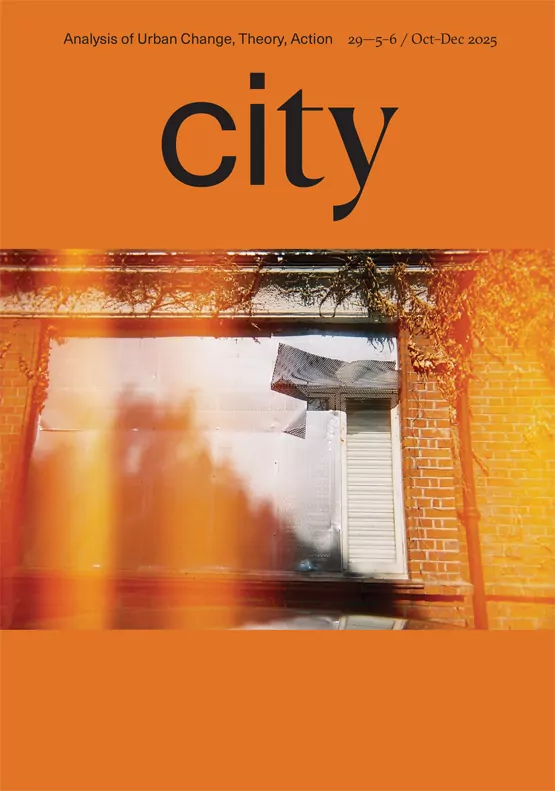
city: issue 29.5-6
founding editor: bob caterall
city: issue 29.5-6
editor: city editors
editorial: Property/trespass and squatting in cities
Samuel Burgum
“The spaces we need are already all around us.”
“Squatters are people using their city.”
“Squats are a window onto the city.”
I started writing something about squatting in London.But you soon find yourself pulling on threads entangled across diverse urbanhistories and borders, unravelling complex genealogies of land use, settlement,property, ownership, entitlement, boundaries, and enclosure. I needed anapproach which might help me begin tracking how ‘squatting’ travels across these, whilst remaining open to the complexities of context. Here, by presentingan unsatisfactory definition of squatting, my aim is to start with something I canthen set about disentangling:Squatting is (1) a specific type of trespass of unused and wasted properties motivatedby an ongoing need for space, and (2) a type of occupation which seeks to justify itselfthrough use rather than ownership or permission.Part (1) is intended to be specific. By intentionally using the term ‘trespass’ I meanto position squatting in opposition to property as ownership. When an action islabelled, stigmatised, and criminalised as ‘trespass’, it implies a construction ofproperty ownership: i.e. an entitlement claim over the space and a moral ‘right’ ofthe owner to possess, control, and exclude (Singer 2000). The types of actions andpeople labelled ‘trespass’ are historically constructed, bringing specific lineagesof normative power and violence. On the ground, spaces are being (re)performedeveryday in ways that continually blur and crossover boundaries of propertyentitlement. But whenever trespass is designated, and ownership is reasserted,the aim is to shut down, reduce, simplify, and tidy up this kind of complexity,into the simple binary of formal owner vs. non-owner. Or as Nick Blomley putsit, under ownership, ‘the meaning of property appears settled … [it] presumesclarity and determinacy in the definition of what property is, and tells us whichrelationships between people and scarce resources are to be valued as such,and which are not’ (2004, xiv). Ownership, in other words, makes the questionof how space is distributed abstract, removing it from material realities on theground, and towards technologies such as surveys, titles, registers, contracts,court orders, police, bailiffs, military …
click here to read the full editorial.
announcement
abstract / preview
Abstract
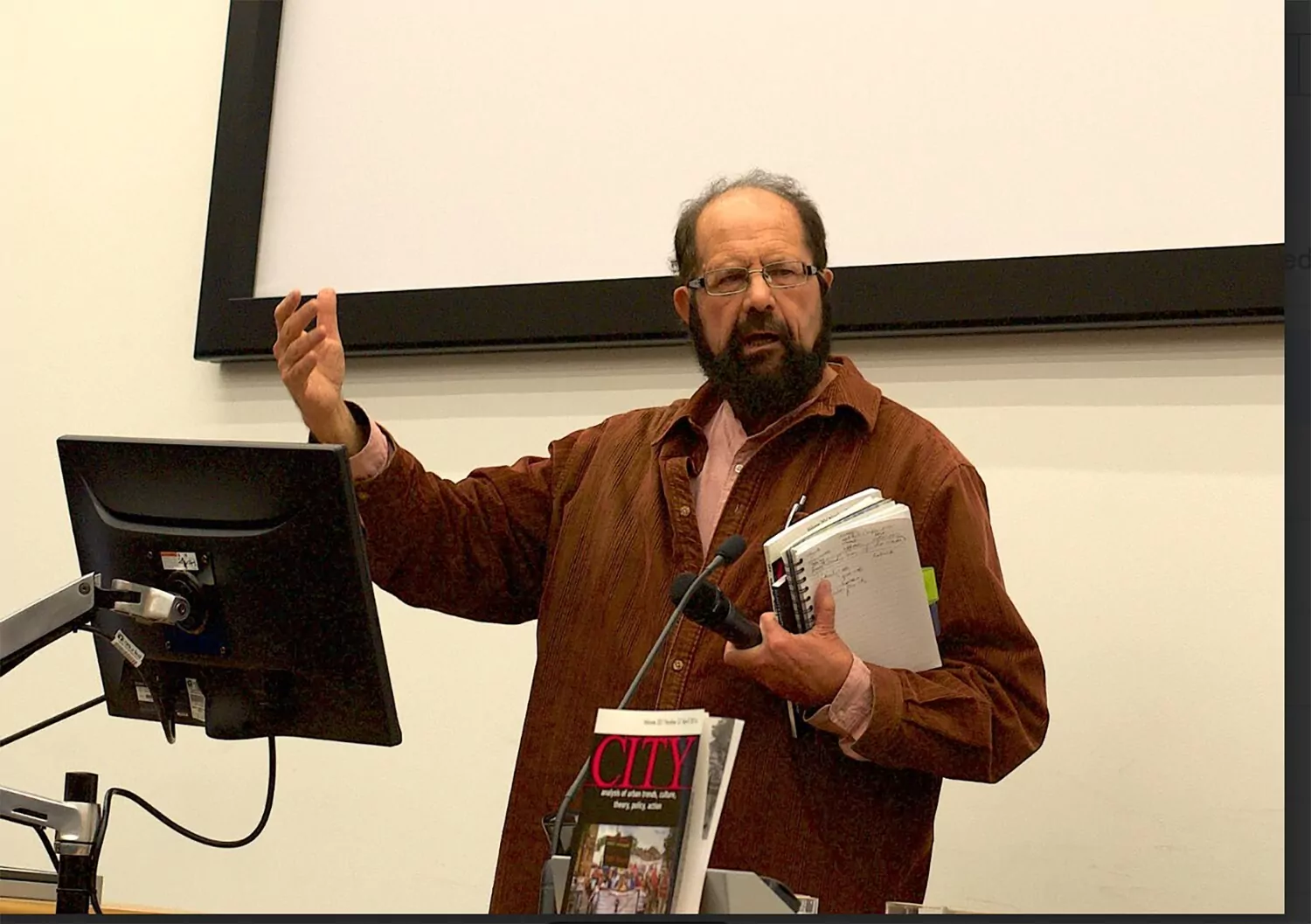
Remembering Bob Catterall
"Remembering Bob Catterall." City, 29(5-6), p. 707
editorial

abstract / preview
Abstract
Property/trespass and squatting in cities
No abstract available yet for this article.
forum: climate change and urban-agrarian solidarities

climate change and urban-agrarian solidarities
keywords: agrarian studies, urban studies, climate change. political solidarity. social reproduction
abstract / preview
Abstract
Climate change and urban-agrarian solidarities
As climate change has heightened the significance of urban-agrarian material entanglements and intellectual and political oppositions, the need to speak across them has become more urgent. Scholarship in agrarian and urban studies is concerned with specific social processes and political demands in agrarian and urban contexts, respectively. These processes and demands are often articulated in opposition to one another, despite the fact that the places and people each studies are materially and politically connected. This paper argues that scholars in these fields should not only work to understand how these dynamics across space are materially interconnected, but also where and how their politics converge, in order to move from a position of opposition to one of solidarity. We trace entanglements across urban and agrarian studies and spaces through the lenses of food, energy, and water to identify: (1) relational material and political dynamics and (2) through the lens of social reproduction, shared demands across differently articulated political claims. We conclude by describing work of translation, commensuration, and imagination that scholars might engage in to facilitate understanding and coalition-building across urban and agrarian studies and movements.

agrarian questions for an urban world: response to ‘climate change and urban-agrarian solidarities’
keywords: migration, climate change, labor, agrarian question, social movements
abstract / preview
Abstract
Agrarian questions for an urban world: response to ‘Climate change and urban-agrarian solidarities’
Rural politics will make or break climate action. The material flows between city and country—food, water, and energy—have been established as an extractive relationship that delivers resources on the cheap, a cheapness both rural and urban working people depend on. This essay contributes to the dialog between urban and agrarian studies on how to navigate such contradictions to avoid backlash to climate policies. I have three main lessons from debates on climate in critical agrarian studies for urban studies scholars interested in climate action. First, ecological agrarian questions including the extraction that underpins cheap food for urban and rural working people alike is as much or more important for understanding rural challenges than climate change itself. Second, any attempt to create urban-agrarian solidarities, especially around climate change, needs to understand the politics of rural labor, race and social reproduction in order to articulate shared interests and identities. Ecomodernist visions fail to do this. Finally, climate politics have to materially improve the lives of both urban and rural working people in order to actually succeed.

unities and distinctions: the country and the city, the agrarian and the rural, scales and polities, and rights and utility in the era of climate change. response to ‘climate change and urban-agrarian solidarities’
keywords: capitalist development, climate change, agrarian studies, rural geography
abstract / preview
Abstract
Unities and distinctions: the country and the city, the agrarian and the rural, scales and polities, and rights and utility in the era of climate change. Response to ‘climate change and urban-agrarian solidarities’
In response to ‘Climate change and urban-agrarian solidarities’ by Angelo, Goh, and Paprocki (Angelo, Hillary, Kian Goh, and Kasia Paprocki. 2025. “Climate Change and Urban-Agrarian Solidarities.” City: 1–30. https://doi.org/10.1080/13604813.2025.2512623), this essay uses the work of Raymond Williams as a stepping-off point to make three arguments regarding how to theorize relationships between urban and agrarian geographies and politics in the era of climate change. The first is that our analyses should begin from the structuring processes and relationships that produce categories such as ‘urban’ and ‘agrarian,’ rather than beginning and proceeding from an acceptance of those categories as commonly used. The second is that it could be productive to consider alternate terminologies, such as ‘rural,’ and consider what is emphasized or deemphasized in both the terms themselves, and the scholarly literatures organized around them. The third is that the challenging work of building political solidarities across diverse geographies could be facilitated by more explicit attention to the concepts and vocabularies of scale and polities on the one hand, and rights-based vs. utilitarian frameworks on the other.

undocumented labor, real property, and the building of commensuration. response to ‘climate change and urban-agrarian solidarities’
keywords: undocumented, farmworkers, real property, immigration enforcement, commensuration
abstract / preview
Abstract
Undocumented labor, real property, and the building of commensuration. Response to ‘Climate change and urban-agrarian solidarities’
In this commentary, I suggest that scholars center struggles—like those faced by undocumented food system workers—that are very much embedded in both agrarian and urban questions but do not clearly present as either, as one way through the urban/agrarian divide. Furthermore, through reference to the shared legal status of rural land and urban housing as real property, I assert the possibility of building commensuration through movements and activism focused on questions of real property ownership and control.

more-than-urban coalitions for socio-ecological reproduction. response to ‘climate change and urban-agrarian solidarities’
keywords: planetary urbanization, climate change, counter-hegemonic climate politics, socio-ecological reproduction, global infrastructure
abstract / preview
Abstract
More-than-urban coalitions for socio-ecological reproduction. Response to ‘Climate change and urban-agrarian solidarities’
This response paper engages sympathetically with Angelo, Goh, and Paprocki’s call for research to support solidarity-based urban-agrarian political coalitions in the face of climate change. Our response, as researchers concerned with questions of extended urbanization and the planetary urbanization debate, touches upon both their analysis and recommendations. For the former, we suggest the need to contextualize the political ecology of urban-agrarian entanglements within infrastructure-led territorial transformations and the emerging peri-urban geographies of precarity that characterize operational landscapes beyond existing cities. We also reflect on long-standing tensions between the urban and the rural. For the latter, we call for an understanding of social reproduction that takes nature seriously. Forging solidarities around socio-ecological reproduction can inform counter-hegemonic politics in an age of climate breakdown when urban and rural communities need to contend not only with the commonsense of neoliberal sustainability but also the consolidation of supremacist survivalism.
original articles

plural commons: translation as a relational practice
keywords: commons, commoning, pluriverse, translation, equivocation
abstract / preview
Abstract
Plural commons: translation as a relational practice
The widespread use of the English term commons, rooted in British history, often obscures the diverse ways in which collective life, stewardship, and organising are practiced across different cultures. This paper asks how such distinct experiences can be translated and connected without collapsing their differences. Building on the work of the Urban Commons Research Collective, we argue that translation—while always imperfect—is crucial for forging solidarities across contexts. Drawing on feminist decolonial thought, we introduce relational translation as a practice that both connects and carefully situates experiences of the commons within their specific histories and struggles. Central to this approach is the use of equivocation as a methodological tool: one that engages with misalignments between terms as openings for dialogue, rather than obstacles. By tracing key vocabularies of commoning across diverse contexts, the paper develops a plural understanding of the commons and proposes a tentative framework for connecting different practices without reducing their plurality.

inherited obligations and architectures of debt: reimagining futures for kingston, jamaica
keywords: debt, finance, urban governance, public-private, land grabbing, rent gap, aesthetics
abstract / preview
Abstract
Inherited obligations and architectures of debt: reimagining futures for Kingston, Jamaica
This article examines how contemporary forms of debt—understood in financial and ethico-political terms—impact on the Jamaican built environment in particular and implicates more generally the current construction drive in the Caribbean and the postcolonial built environment across time. We do so through the controversy that followed the 2017 agreement between the government of Jamaica and China Construction America, the purpose of which was to carry out a radical urban transformation of Downtown Kingston. We argue that the ongoing construction phase in the Caribbean perpetuates spatio-political structures that organise dispossession and debt: from the agreement mechanisms adopted for the design, construction and maintenance of urban developments on the island, to the political, urban and architectural legacies and obligations mobilised throughout the said controversy, which acutely intensified with the master plan conceptualisation for the government campus and a new Houses of Parliament. Here, on the urban and architectural site of national governance and political representation itself, we reveal the urban and architectural form of a dominant politics of demolition and exclusion that is perpetuating in contemporary urban Jamaica.

new cartographies of heterotopic posturban cities in s. b. divya's machinehood (2021)
keywords: space, cyborgian flâneur, posturban city, me++, neoliberalism, posthuman architecture
abstract / preview
Abstract
New cartographies of heterotopic posturban cities in S. B. Divya's Machinehood (2021)
Contemporary postmillennial Indian speculative fiction serves as a performative ideogram to accentuate space as the ongoing possibility of differential posthuman inhabitation and pluriversal subjectivities. Set against S. B. Divya's Machinehood [2021. Machinehood. India: Hachette India], this article adopts a new-materialist standpoint that emphasises the technological co-spatialization of everyday life in the contemporary city overlaid by mutable new cartographies. Divya's fiction interpolates a posturban future shaped by neoliberal order, hyper-surveillance, and platform-mediated gig economy, which is richly imaginative and eerily familiar. The present study challenges dominant narratives of androcentric cartography and the topography of the humanistic architectural order by invoking a cyborgian motif. A cyborgian flâneur is a co-spatial transgressive metabody of contingency and recursive differentiations, which transpires as a multi-layered apparatus of knowledge-making, heteroglot politics, and local literacy in a techno-corporeal posturban city. The analysis critiques the dissolving boundaries between human and machine by reworking the notion of the human body as Me++, a networked body interfacing with avant-garde architectural semiology by extending its sensoria through information technology.

imposing immobility and making mobility: an infrastructural reading of beijing’s impactful but ineffective temporal mode of covid governance
keywords: infrastructure, pandemic, chinese urbanism, governance, temporality
abstract / preview
Abstract
Imposing immobility and making mobility: an infrastructural reading of Beijing’s impactful but ineffective temporal mode of COVID governance
This study examines China’s COVID governance through the case of Beijing from April to June 2022. To manage the biopolitical paradox between mobility and immobility brought forward by the pandemic, the Chinese state mobilised a temporal mode of COVID governance, implementing drastic containment measures aimed at ‘zeroing out’ viruses in the shortest possible time while minimising socio-economic cost. This approach entailed imposing immobility and making mobility according to the specific temporal—spatial arrangements of time—space compression in a state of exception, within which a spatial configuration of simultaneity for infrastructural intervention emerged. However, the two groups of infrastructures deployed for these purposes ultimately generated excessive socio-economic costs, while achieving ‘zeroing out’ over an extended period, revealing Beijing’s impactful but ineffective COVID governance. This outcome invites reflection on how China’s temporal mode of governance was enacted and reciprocally challenged by the very infrastructures deployed as its instruments.

governing infectious disease in the urban periphery: marginality, informality and vulnerability
keywords: covid-19, informal settlements, peripherality, extended urbanisation, governance
abstract / preview
Abstract
Governing infectious disease in the urban periphery: marginality, informality and vulnerability
This paper works toward building a theoretical framework to understand the role that extended urbanisation and peripherality played in the COVID-19 pandemic, with a specific focus on conceptualising and analyzing the nature of the social impacts and outbreak responses that unfolded in urban peripheries. In particular, we emphasise how scholarship on socio-spatial peripheralisation—as part of broader approaches devoted to analyzing the nature of extended urbanisation more generally—may vitally inform current discussions about the ways the urban periphery continues to be defined and debated in the wake of the pandemic. We make the case that governance of urban society must accept and respond to the territorial and scalar perforations, multiple diversities and deepening inequities that were highlighted in the pandemic. The chief contribution of this article is that the ways the urban periphery has been defined and debated has been associated with the changing political ecologies of urbanisation. To analytically explore this relationship we deploy and extend relevent concepts like extended urbanisation and suburbanisation, peripherality, marginality, and informality. Our intervention in the distinct but related debates on extended urbanisation and peripheralization adds a further dimension to consider in the governance of disease and cities.

‘we are being squeezed out’: studentification, working-class displacement and resistance in hulme, manchester
keywords: displacement anxiety, displacement pressure, resistance, studentification, purpose-built student accommodation, univercitytification
abstract / preview
Abstract
‘We are being squeezed out’: studentification, working-class displacement and resistance in Hulme, Manchester
This paper examines the nature of ‘studentification’ in Hulme, an inner-city area of Manchester, and how this process is responded to by working-class residents of the neighbourhood. We pay particular attention to the building of purpose-built student accommodation (PBSA), which we characterise as a distinctive ‘second stage’ of studentification which, following Baldwin (2021. In the Shadow of the Ivory Tower: How Universities Are Plundering Our Cities. London: Hachette UK) and his notion of the ‘UniverCity’, we conceptualise as the corporate ‘univercityfication’ of Manchester and Hulme. We locate the temporal nature of studentification within a broader ‘long view’ perspective on housing and urban policy—in this case the multiple rounds of demolition and redevelopment that Hulme has experienced since the 1950s. Hulme residents have played an active role in relation to such redevelopment, often contesting the various plans which have been put forward, including the recent PBSA developments. Although Hulme has been a home to students dating back to the 1970s, their co-presence has taken on an increasingly threatening form during the last decade due to the development of a new university campus and large-scale PBSA building. Such development is a key part of Manchester's urban policy strategy, a city well-known for its neoliberal tendencies. The paper argues that Hulme’s working-class population has shifted in its response to such studentification: from initial welcoming to outright opposition to the latest PBSA planning incarnations. We analyse how and why this changing response has occurred and emphasise how PBSA operates as a highly exclusionary mechanism within urban redevelopment. Working-class Hulme residents have witnessed the loss of their previous community facilities and are increasingly experiencing both ‘displacement pressure’ (Marcuse. 1985. “Gentrification, Abandonment and Displacement: Connections, Causes, and Policy Responses in New York City.” Wash. UJ Urb. & Contemp. L. 28: 195), and ‘displacement anxiety’ (Watt 2018. “‘This Pain of Moving, Moving, Moving’: Evictions, Displacement and Logics of Expulsion in London.” L’ Année sociologique 68 (1): 67–100. https://doi.org/10.3917/anso.181.0067). They anticipate that the remaining social housing will eventually be demolished and they themselves—‘a community of ghosts’—will be physically relocated away from the area. Such displacement concerns underpin the local ‘Block the Block’ campaign which vigorously challenged the latest PBSA proposal on the site of an old pub from 2020 to 2024.

capturing the urban palimpsest: late-photography and the banality of surveillance in henrietta williams’s ring of steel (2011)
keywords: surveillance, terrorism, late-photography, palimpsests
abstract / preview
Abstract
Capturing the urban palimpsest: late-photography and the banality of surveillance in Henrietta Williams’s Ring of Steel (2011)
The Ring of Steel is a security cordon built around the City of London following two IRA bombs in the 1990s. As a piece of counter-terrorist infrastructure it aims to be covert and opaque—something given renewed emphasis in a proposed upgrade. I critique the inherent dangers in such covert security infrastructure and the ‘banal surveillance’ it enables. These dangers range from a lack of public oversight to an increased reliance on technological biases—a process Simone Browne has likened to ‘digital epidermalism’. Key to my critique is my analysis of Henrietta Williams’s 2011 photographic series documenting the Ring of Steel. Putting Williams’s late-photographic aesthetic in dialogue with theories of urban palimpsests, I argue that she makes known what Steven Graham would call the Ring of Steel’s ‘manufactured ground’. My reading of Williams’s photographs hereby interrogates the contradictions of surveillance in the twenty-first century city. While the gloss of technological advancement suggests we are entering a digital future of efficiency and objectivity, Williams places the mirage of that metaverse against the earlier foundations of London’s defences. Here, she reminds us of the exclusory perspectives that subtend surveillance architecture—no matter how neutral, or banal, that infrastructure appears to be.

spatial tactics and sliding signs/symbols alongside a middle-aged ‘neurodivergent’ man and possibilities for troubling and reconfiguring already troubled and troubling classifications and practices in and around the moving city
keywords: neurodiverse geographies, open/closed/moving places, semiotic landscapes, barriers, spatial tactics, classification
abstract / preview
Abstract
Spatial tactics and sliding signs/symbols alongside a middle-aged ‘neurodivergent’ man and possibilities for troubling and reconfiguring already troubled and troubling classifications and practices in and around the moving city
This article critically reflects upon journeys taken in and around the city alongside a middle-aged ‘neurodivergent’ man often labelled ‘non-verbal’ and ‘challenging’. These forays, on foot and by car, which are conceptualised as spatial tactics, are deployed as prisms through which to reflect upon the things making up these places. Place is initially read as a coherent and cohesive text, or semiotic landscape, constituted by clear and determinate signs. However, this article becomes increasingly preoccupied by things which seem to evade, and complicate, fixed and unitary meanings. Place-based barriers are not ‘out there’ in place but constituted by apparently innocuous things, including ourselves. These shapeshift, accumulating meanings in the spaces in/between people in environments shaped, albeit not determined, by complex cultural/historical constructions. Meanwhile, other, seemingly contradictory, symbols—notably dog faeces and discarded cans of beer—individually and collectively make a troubled, or moving, ‘collage’ communicating multiple messages about matters in/out of place, inclusion/exclusion, attraction/rejection, desire/disgust, and in/civility. Lenses shaped, sensitised, and perhaps even energised by orientations associated with critical disability studies and neurodiversity studies bring into focus the open-ended, mythical, messy, indeterminate, undecidable, and impermanent qualities of these polyvalent symbols and things. These things accomplish or make up—in the sense of constituting and fabricating—not only ability and disability but also moving places of order and disorder. Such perspectives also illuminate the im/potence and arbitrariness of classificatory acts. Consequently, it becomes possible to think about how people, things, and places overlap and coincide with each other. This illuminates the fictiveness of ‘order’. This also makes it possible to realise and accomplish more inclusive inter/relations, places, and things, and difference for itself.

towards a crisis of resilience? eight takes on a troubling concept
keywords: resilience, crisis, irresilience, united nations, dialectical
abstract / preview
Abstract
Towards a crisis of resilience? Eight takes on a troubling concept
Framed by the contradictory tonalities of United Nations (UN) discourse, the paper argues that the global governance concept of resilience is being drawn into the very crises it seeks to mitigate, pointing to a possible crisis of resilience as a master concept for governing the Risk Society. Through a wide-ranging interdisciplinary review, the paper therefore reconsiders the utility of the concept in addressing anthropocenic crises, and potential strategies for addressing the cognitive dissonance evoked by the UN’s crisis discourse. It elicits three mainstream and five critical strategies for the study and practice of resilience. In synthesising these strategies, it provides conceptual clarification, highlights multiple grounds from which the crisis might be addressed, and seeks to inform future urban research and engagement with evolving theories and practices of resilience.

lefebvre in the digital city: trans-spatial contestations and the co-evolution of protest and control in dhaka
keywords: urban governance, city, social media, trans-spatial protest space, high-risk activism, temporality
abstract / preview
Abstract
Lefebvre in the digital city: trans-spatial contestations and the co-evolution of protest and control in Dhaka
This paper examines the evolving dynamics of protest in urban Bangladesh by analysing the temporal interplay between public space, activism, and state control. Social movements have played a crucial role in shaping Bangladesh’s political landscape, from the 1971 liberation struggle to the transition to parliamentary democracy in the early 1990s. Over time, the spatial tactics and forms of these movements have shifted. Drawing on ethnography in Dhaka, this paper extends Lefebvre’s triadic spatial model into a trans-spatial, conjunctural, and temporally recursive framework that reveals protest space as dynamically co-produced across digital and physical terrains. The concept of trans-spatiality captures how resistance traverses street, screen, and body, generating affective and symbolic inscriptions. It theorises protest space as produced through three intersecting dialectics: between abstract and lived space in the physical realm, between algorithmic abstraction and digital lived space, and between physical and digital terrains. The paper, thus, offers a framework to understand urban protest spatialities as dynamic, historically layered, and digitally entangled.

toward a sensory approach to tactical urbanism
keywords: tactical urbanism, sensory urbanism, sonic environment, participatory design, urban livability
abstract / preview
Abstract
Toward a sensory approach to Tactical Urbanism
In the last decades, Tactical Urbanism has emerged as a bottom-up approach addressing the state of abandonment or underuse of problematic urban areas through ephemeral, temporary interventions aiming to trigger positive and long-term benefits to derelict areas. While Tactical Urbanism interventions usually have a strong visual component, in this article we focus on the possibilities offered by sound-based tactical interventions informed by participatory design processes engaging residents and local actors of neighborhoods undergoing transformation. Highlighting the role of city users’ sonic experience in the everyday environment, we illustrate how a sound-based approach to Tactical urbanism can help exploring alternative means of questioning neoliberal urbanism, especially by supporting the livability of residents and city users beyond the primary drive toward visitors’ attractiveness. To support our argument, we present and discuss the outcomes of a two-year project in the Montreal’s Quartier des Spectacles, a neighborhood undergoing drastic social, spatial, and economic transformations. Here, after a first ethnographic and sonic investigation, we organized two participatory workshops focused on the sonic experience of the neighborhood, which culminated in the realization of a sound installation.

theocratic authoritarian urbanism and performative right to the city: a case study of tehran’s city theatre
keywords: authoritarian urbanism, cultural heritage preservation, public space contestation, tehran city theatre, theocratic regime
abstract / preview
Abstract
Theocratic authoritarian urbanism and performative right to the city: a case study of Tehran’s City Theatre
Authoritarian regimes govern through space as well as law and ideology. This paper examines the enclosure of Tehran’s City Theatre not merely as a preservation measure, but as a spatial intervention that reconfigures access, visibility, and memory in service of theocratic control. In Iran, where public space is tightly bound to moral doctrine and surveillance, urban planning becomes a tool of ideological discipline. Revisiting Henri Lefebvre’s Right to the City, this study asks how this right is enacted when institutional participation is foreclosed and dissent is criminalized. Drawing on media archives, architectural histories, and digital traces, it interprets the fencing of the theatre as both material enclosure and symbolic erasure. I argue that under theocratic authoritarianism, the Right to the City is reconfigured—not extinguished—manifesting through gestures of refusal, mnemonic practices, and affective forms of civic presence. Rather than being claimed through institutional channels, the Right to the City emerges through symbolic endurance and spatial storytelling. This reimagining extends Lefebvre’s framework to ideological repressive regimes, where spatial justice unfolds not through participation, but through the performance of presence.

a class act: buildings, contingency, and urban limits
keywords: buildings, gentrification, abandonment, urban studies, class, south america, political economy
abstract / preview
Abstract
A class act: buildings, contingency, and urban limits
Exploring the case of an abandoned old factory in Santiago, Chile, this article unpacks the process of class-driven urban renovation reorganizing a working-class neighborhood. Combining urban studies, anthropological and state theory, and built upon ethnographic work, this analysis addresses the organization of the building as both a material spatial artifact and an economic unit to address the forms of urban governance driven by class warfare. Although it might sound hyper-ideologized, class plays a vital role in managing a fixed urban asset, such as the building studied in this article. Despite having formal, longstanding tenants and regular temporary activities hosted within its interior, a post-industrial white elephant in the middle of an up-and-coming neighborhood is declared abandoned by the city mayor and entrepreneurs. This is done to cement a new movement in the decade-long process of neighborhood commercial gentrification. Abandonment and class are embodied by narratives that can be identified in an urban unit, which will lead to major reconfigurations of the building and neighborhood users, establishing limits to entrepreneurial activities, wealth accumulation and, eventually, a right to the city and commerce mediated by class structures.
special feature: decolonising urban knowledge(s): an ordinary imperative in extraordinary times

aquilombar the city: women of the favelas and city-making in rio de janeiro
keywords: quilombo, favelas, women, city-making, decoloniality, feminism
abstract / preview
Abstract
Aquilombar the city: women of the favelas and city-making in Rio de Janeiro
This paper explores the concept of aquilombar as a paradigm for understanding the city-making practices of women living in the favelas of Rio de Janeiro. Drawing on Afro-Brazilian historian Beatriz Nascimento’s conceptualization of the quilombo, I argue that aquilombar—the act of creating quilombos—engages with Afro-diasporic cosmologies and shapes the everyday practices of city-making among favela women. Situated within a broader decolonial and feminist framework in urban studies, these practices are understood as a pluriversal-izing form of urbanization—that is, as part of the multiple social imaginaries and worldviews shaping urban transformations. Through an extensive examination of the historical origins of the terms kilombo, quilombismo, and quilombo, with a primary focus on Nascimento's scholarship, I first propose a working definition of the verb aquilombar. Drawing on key examples collected during my most recent 2025 fieldwork, alongside my longer engagement with the favelas, I then connect Nascimento's understanding of the quilombo with favela women's own interpretations. In doing so, this paper highlights the specific gestures, actions, and ways of knowing through which women in the favelas actively shape their city, despite living within an often-hostile urban environment.
scenes sounds action

women in the centre: dialogue on past and present community-led planning in birmingham (uk)
keywords: feminist planning, community planning, radical planning, planning histories, participation, birmingham
abstract / preview
Abstract
Women in the centre: dialogue on past and present community-led planning in Birmingham (UK)
This essay draws on dialogue generated during a workshop in Birmingham (UK) in which campaigners, historians, artists, academics, students and community organisers came together to discuss the histories and legacies of a city that underwent one of the most radical modernist planning regenerations in post-war Britain. The workshop used a case study of a campaign group, Birmingham for People’s Women’s Group, as a springboard for discussion about the impact and exclusions of planning in Birmingham. Birmingham for People’s Women’s Group emerged in 1989 and worked with voluntary and state actors across the city until the mid-1990s, influencing planning policy to include the needs of women. They addressed the problems arising from a city that had been built on the model of the motor city and for the international commuting businessman, which worked to exclude women and other social groups. Their work led to women’s needs being incorporated into City planning policies, urban design and educational resources. The workshop participants explored the interaction between past and present in a discussion that ranged both temporally and geographically, before and after the Women’s Group’s intervention. They discussed the continuities and repetitions and the breaks and shifts over time in urban planning, and community challenges to it. Through quoted dialogue, this essay also aims to capture the value of coming together in discussion as a way to generate ideas and build understanding. It also contributes to a radical planning history project.

the future of the past: barcelona’s rec comtal
keywords: hydraulic infrastructure, urban futures, heritage, urban commons, landscape architecture
abstract / preview
Abstract
The future of the past: Barcelona’s Rec Comtal
This essay examines the contemporary significance of the Rec Comtal, a millennium-old canal that once served as a major water infrastructure in Barcelona. Following its functional decline in the 20th century, the Rec has recently resurfaced in various domains—including archaeology, urban planning, and grassroots activism—becoming a site of contested meanings and future imaginaries. Through four ethnographic ‘scenes’ located along the canal’s path, we examine how the Rec has been re-signified as official heritage, future green infrastructure, common resource, and space of unsanctioned leisure. Rather than a relic of the past, the Rec emerges as a dynamic infrastructure through which multiple, and often conflicting, visions of the city’s history, governance, ecology, and future aspirations are channeled.

appropriation of space: el arbol settlement as a space of resistance in the city of santiago de cali, colombia
keywords: spatial, appropriation, symbolic identification, settlement, oral history, political ethnography
abstract / preview
Abstract
Appropriation of space: El Arbol settlement as a space of resistance in the city of Santiago de Cali, Colombia
This piece documents the struggle of El Árbol, an informal settlement that emerged between 2009 and 2014 in Santiago de Cali, Colombia, where families displaced by violence and poverty transformed an abandoned plot of land into a collective home. Through practices of spatial appropriation, grassroots organization, and political resistance, its inhabitants confronted forced evictions, militarization, and persistent stigmatization, responding with community labor and collective mobilization. Grounded in a qualitative ethnographic strategy, the study employs two key participatory methodologies: the collection of oral testimonies and the co-construction of community maps. In-depth interviews and life histories with residents helped reconstruct memories of forced displacement, the processes of territorial appropriation, and the formation of grassroots collective organization from an embedded perspective. In parallel, participatory mapping workshops were conducted to collaboratively design maps that reflect the settlement’s evolution, the places of symbolic significance, and the key milestones of the urban conflict. These methodologies not only served to document events, but also activated processes of political subjectivation among participants, generating knowledge rooted in the embodied experience of inhabiting.
reviews

abstract / preview
Abstract
Prefiguring liberatory futures
No abstract available yet for this article.
abstract / preview
Abstract
Home is where the hatred is
No abstract available yet for this article.

abstract / preview
Abstract
Estate regeneration: learning the lessons
No abstract available yet for this article.

abstract / preview
Abstract
Reclaiming the right to space in the city
No abstract available yet for this article.

abstract / preview
Abstract
Dreaming the city otherwise
No abstract available yet for this article.