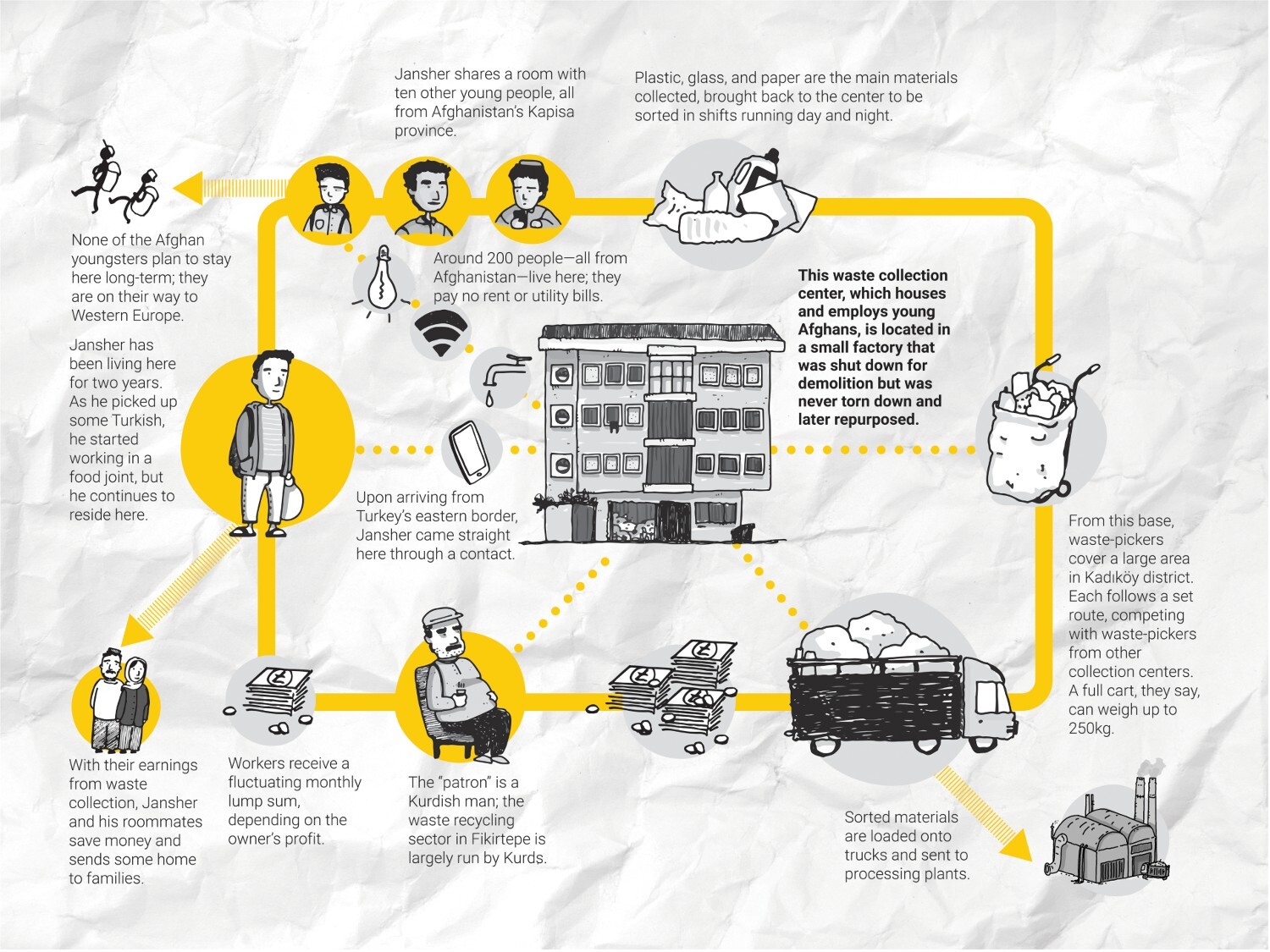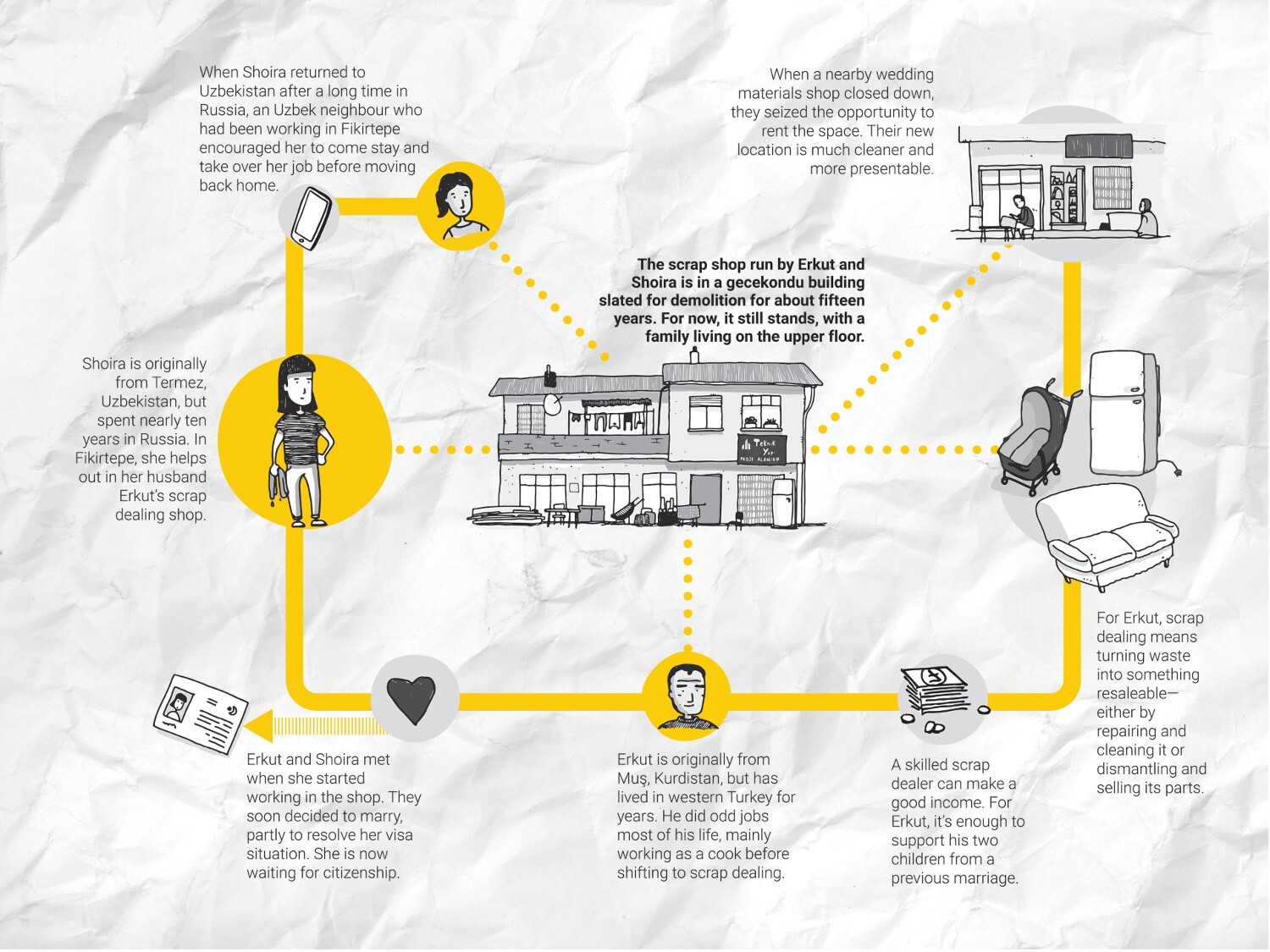
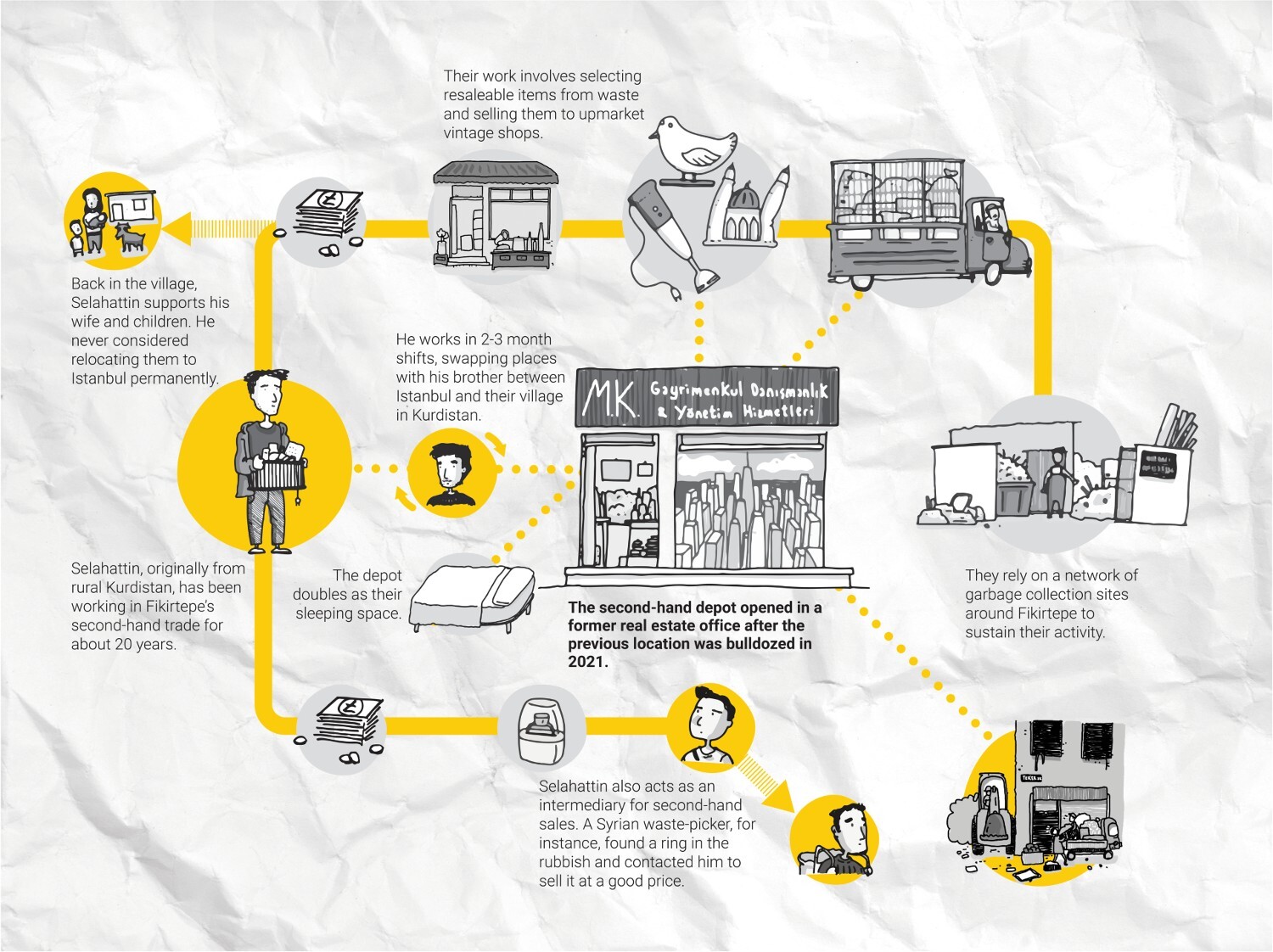
as intensifying circulations of people and capital collide in globalizing cities and make inhabitation increasingly unsettled, disparate migratory mobilities become entangled within broader place-based circuits formed with, and through, scraps: material leftovers, places deemed ‘beyond repair’, individuals rendered expendable, and practices considered marginal. this contribution draws on ethnographic fieldwork (2018–19, 2021–23) in fikirtepe, istanbul, an ‘informal’ neighborhood undergoing large-scale redevelopment that, since 2005, has been repeatedly postponed, nearly collapsed, and only recently resumed—though with no clear end in sight. through examples of daily life and illustrated diagrams, i attempt to convey the complex interconnections of re-purposing and re-composition that provide a basis for urban inhabitation under conditions of structural violence and prolonged displaceability. here, wasted elements are stitched together through improvised collaborations and unstable arrangements that, in aggregate, allow disparate individuals—those who have come to inhabit the extended temporality of urban transformation—to hold on within the center of the metropolis, yet only temporarily.
Keywords:
‘if the sofa’s in good shape, you resell it. if it’s beyond repair, you chop it for firewood,’ erkut explains, intent on repairing a hair dryer. scrap dealing is an art—you need to know what you’re doing. outside erkut’s makeshift gecekondu shop in the neighborhood of fikirtepe, istanbul, salvaged stools, tables, and heaters line the pavement, ready for sale.
a faded developer’s sign clings to the shabby two-story building. according to turkey’s government plans, developers were expected to strike deals with homeowners with minimal government oversight to remake this informally developed neighborhood, regularized in the early 1990s and located close to istanbul’s center. with an unprecedented increase in construction rights and generous incentives for property mergers, the expected windfall would smooth disputes and fast-track fikirtepe’s transformation into ‘turkey’s manhattan.’
work on the redevelopment began in 2013, leveling hundreds of buildings and leaving many more empty, with construction starting on high-rise ‘luxury’ residences. but progress stalled due to multiple setbacks, and after the 2016 economic downturn, many developers went bankrupt or disappeared. yet the plan was never canceled—only repeatedly scrapped and rebooted. erkut’s shop sits in ‘phase 2,’ where redevelopment is planned for a looming but unspecified future.